

Website redesign: how to know if you need to redesign your site
Summary (TL;DR)
Website redesign goes beyond aesthetics. More than a new look, it's a strategic revitalization that combines modern design and SEO to boost your results.
Imagine a website that enchants with its beauty, attracts organic traffic, increases conversions, strengthens your brand and keeps up with trends. Read on to find out whether or not it's time to revamp your website.

What is website redesign?
Website redesign, also known as site redesign, is the process of revitalizing and optimizing an existing website. Through in-depth and strategic analysis, a web design company identifies opportunities to improve user experience, increase the site's performance and boost the achievement of your online goals.
Why invest in a website redesign?
A well-executed website redesign can bring several benefits, such as:
- Improve the user experience: A website with a modern, intuitive and responsive design provides pleasant and fluid navigation on any device, retaining your visitors and converting them into customers.
- Increase traffic organic: By optimizing your site for search engines (SEO), you make it more visible to potential customers looking for products or services like yours.
- Improve conversion: A website with strategic design and relevant content facilitates the customer journey, increasing the chances of conversion into sales, leads or other desired actions.
- Strengthen the brand: A modern, professional website helps to build a positive image for your brand, conveying reliability and professionalism.
- Follow the trends: The digital market is constantly evolving, and a website redesign allows you to incorporate the latest trends in design and technology, ensuring that your site is always up to date.
When is a website redesign necessary?
Some signs that indicate the need for a website redesign include:
- Outdated design: If layout If your website is outdated, with colors and fonts that don't match your brand's visual identity, it's time to modernize it.
- Low traffic and conversion: If your website isn't attracting visitors or converting them into customers, a redesign could be the solution to increasing your online performance.
- Difficulty navigating: If your site is difficult to navigate or isn't responsive for mobile devices, you're missing out on a lot of potential visitors.
- SEO problems: If your site is not optimized for search engines, it will struggle to appear in search results, which limits your online reach.
- Changes in the company's strategy: If your company has undergone rebranding or changes in business strategy, the site needs to be updated to reflect these changes.
Website redesign with a focus on SEO
A website redesign with a focus on SEO goes beyond aesthetics. It is a strategic process aimed at optimizing the site for search engines, increasing its online visibility and attracting qualified organic traffic.
Some SEO techniques that can be used during website redesign include:
- Keyword research: We identify the relevant keywords for your niche market and include them strategically in the content of your site.
- Optimization of titles and meta descriptions: We create attractive titles and meta descriptions optimized for search engines, increasing the click-through rate (CTR) in search results.
- Content optimization: We produce high-quality content that is relevant to your target audience, optimized for the keywords you have chosen.
- Image optimization: We included descriptive alt text and optimized the size of the images to ensure the site loaded quickly.
- Data structuring: We have implemented structured data to facilitate indexing of the site by search engines.
- Creation of backlinks: We build quality backlinks to your site from other relevant sites, increasing your online authority.
High bounce rate
Website analytics show more than just how users navigate your site. They also show whether or not you should optimize your site's design.
One of the biggest analytics you should look at is your bounce rate. Below is a screenshot of where you can find this in the Google Analytics under the Traffic Section found in “Acquisition”:
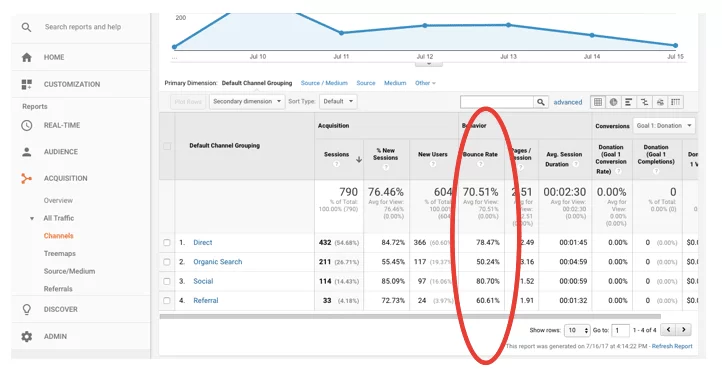
Your bounce rate is the rate at which users are leaving your site. What would cause a user to leave a site? Some factors include:
Slow loading pages
Google promotes high-quality content and pages to its users. Its algorithms rank pages with faster loading times over those with slower loading times. A faster website is not only good SEO practice, it also affects the way your users navigate your page. If a user encounters a slower site, they won't get stuck.
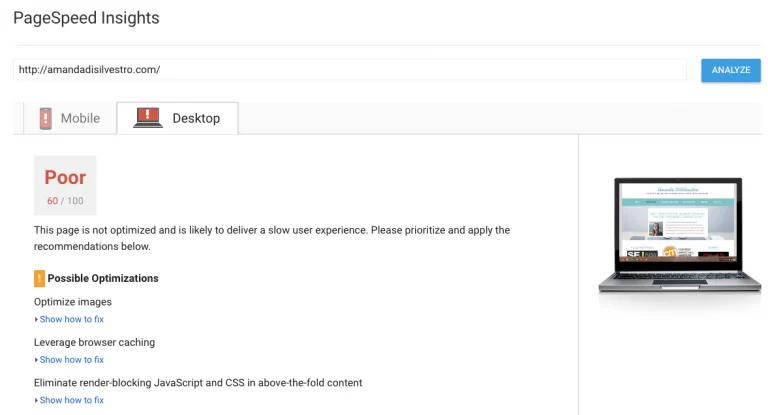
You can check the speed of your site with the PageSpeed Insights tool, shown below. This doesn't necessarily mean that your site needs a total redesign (some things may just need improving), but it could be a contributing factor.
For more tips on getting a grip on your site's speed, check out Ann Smarty's comprehensive piece, “Everything you need to master your site's speed without getting overwhelmed”.
Technical errors
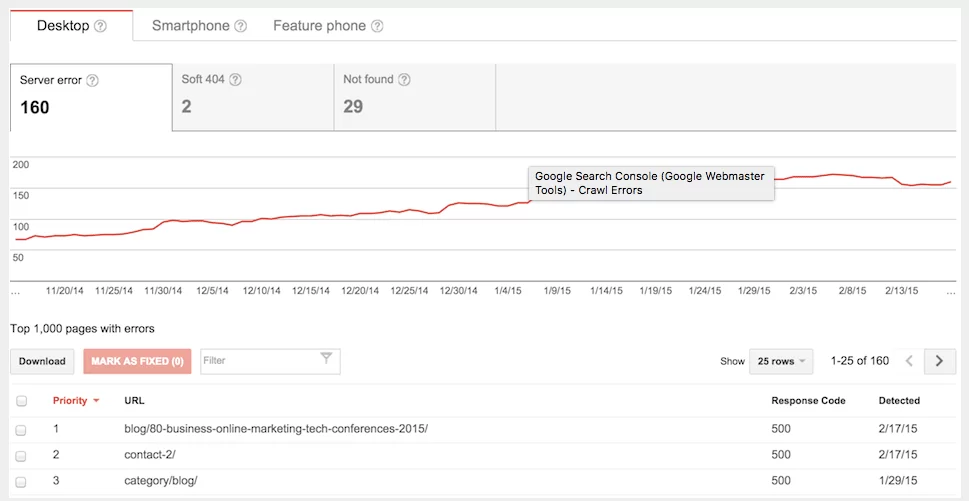
Notice that your bounce rate is suddenly super high? Take a look at how long users are on your page. If they're only sticking around for a few seconds, you may have a 404 problem.
Take a look at your site from the visitors' point of view (use different browsers, as this could also be the problem). You can also use Google Search Console to check for crawl errors.
Poor user experience (UX)
Have you ever been on a website with so many popups that you couldn't find the actual content? Google punishes these types of websites and the average user won't get stuck if they can't find the content they're looking for.
This also contributes to difficult navigation, significantly diminishing the user experience. Make sure your site map is coherent and flows comfortably for the average user.
Mobile-friendly websites
You've heard that more and more users are using their mobile devices to access the Internet. In fact, almost 60% of searches are carried out on mobile devices. Make sure that the buttons on your site are easy to access from a mobile device. Make sure your landing pages are accessible via a cell phone.
Google has an excellent free tool that allows you to test how well your site responds on devices such as smartphones and tablets. Simply enter your site's landing page and let the tool inform you about the performance of your mobile devices. The tool searches at a standard operating level (3G). For example, we did a sample search of Google's site just to give you an idea of how this works.
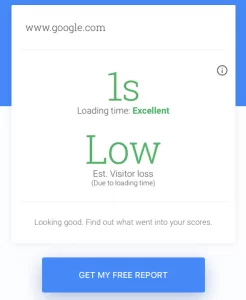
The tool shows how many seconds (or heaven forbid minutes) it takes to load your site on a mobile device. It also shows the estimated percentage of visitor loss you experience due to your loading time. You also have the option of opening a free report that shows you how you can fix problems affecting mobile loading times.
Outdated web design
Have you ever heard that the moment you buy a new computer, it's already out of date? The Internet works in exactly the same way. When you update your website, it's already depreciating.
Remember the websites of the 90s? Flashing buttons, shades of gray and neon colors and lots of graphics? Although many of those sites are still working, they are not attracting the modern user to visit them. For example, see www.ifindit.com.

First impressions mean everything, and that goes for websites too. Not only do you lose credibility with a web design weak, you lose visitors. Haven't updated your site in a while? Here's a quick guide to one of the most up-to-date trends in web design:
Modular design
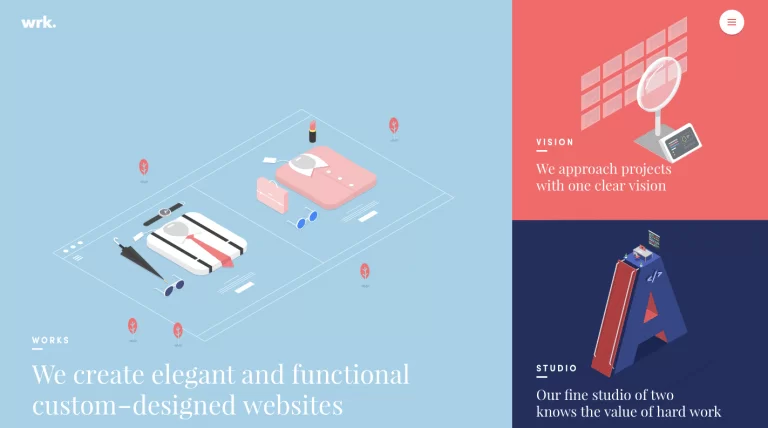
From the simplicity of new websites, modular design is becoming more popular. The basic principle behind modular design is to use a single, flexible template that can be adapted to different types of content, rather than a customized template tailored to each specific type of content. It's the design equivalent of the smart content trend in content marketing.
Although the modular design is not always appropriate for 100% cases, in many of them it is more efficient, less resource-intensive and an easy design for users to navigate.
Here's an example of a website design modular by the Waaark design studio:
Conclusion
Investing in a website redesign with a focus on SEO is a strategic decision that offers long-term returns. By working with experienced professionals, you guarantee optimized website for search engines, ready to attract qualified organic traffic and boost the growth of your business.

Frequently Asked Questions
What is website redesign?
Website redesign is the process of revitalizing and optimizing an existing website to improve its appearance, functionality and performance. It involves a strategic analysis to enhance the user experience, increase the site's efficiency and align its content and design with business objectives.
When is a website redesign necessary?
A website redesign is necessary when the design is outdated, the site has low traffic and conversion, there are navigation difficulties, SEO problems, or when the company undergoes strategic changes, such as rebranding.
How can website redesign improve SEO?
Website redesign with a focus on SEO includes researching relevant keywords, optimizing titles, meta descriptions, content and images, implementing structured data and building quality backlinks. These actions help improve the site's visibility in search engines, attracting qualified organic traffic.
What are the signs that my website needs a redesign?
Some signs include a high bounce rate, slow-loading pages, technical errors, poor user experience (UX), outdated design and lack of responsiveness for mobile devices. If your website has these problems, it's time to consider a redesign to improve your online performance and results.

Caio Nogueira
Caio Nogueira is co-founder of UpSites and a reference in website development and SEO consultancy. With over 10 years' experience and more than 900 projects completed for brands such as KaBuM, UNIMED, USP and Nestlé, Caio stands out for his competence in digital project management.Caio has also been a guest author on influential digital marketing websites such as Neil Patel, Rock Content, Hostinger, Duda, Hostgator and Locaweb, where he has shared his expertise in SEO and content marketing.
See all posts


 Calculate Price Now