

Design de Site: 5 Estratégias de Web Design Infalíveis em 2026
Summary (TL;DR)
Neste artigo, você encontrará um guia abrangente sobre as melhores práticas de web design para 2026, com foco em criar um site marcante e funcional.
The text addresses the importance of a visually appealing and easy-to-navigate design, explaining what website design is and how elements such as colors, fonts and images are essential. Tools and platforms such as Wordpress are discussed as affordable alternatives for creating websites without the need for coding.
Five effective strategies are presented, such as mobile-first design, minimalism, color psychology, F layouts and speed optimization, to improve the user experience and reduce bounce rates.
The article also emphasizes the need for SEO audits and performance analyses to ensure that the site is always up-to-date and efficient.
If you're thinking of creating a new website or improving your website worksIn order to increase your sales, you will need to learn about the best practices of design website in the spotlight at the moment.
Ensuring a strong online presence makes all the difference when it comes to winning new customers and keeping in touch with existing ones.
In this article, you'll find tips on how to create a striking website design.
What is Website Design?
The design of he website is made up of various visual elements, such as colors, fonts, images and logos. These elements serve both to reinforce the brand's identity and to create attractive, easy-to-navigate pages.
Ideally, the site should be easily accessible to everyone, without visitors having to change IP address to access its content.
Advanced tools for Web development, Adobe Dreamweaver requires a solid knowledge of programming and is widely used by professional web designers. This professional must also be aware of the latest trends web design in each market niche.
However, hiring this type of service can be expensive, and individuals and small businesses can't always afford it. Fortunately, there are platforms such as WordPress, where you can create your website from scratch using various templates and online editing tools.
Better still, you don't have to write a single line of code.
You can also change and update your WordPress site design whenever you want, always taking advantage of the hottest trends of the moment.
What's the Need for a Website Redesign?
Investing in redesign of your website is more or less like investing in the refurbishment of your physical store. In both cases, the investment can be for a variety of reasons, from correcting structural problems or expanding capacity, a new visual identity or even moving to types of website different.
Your website may be in need of a redesign if it is presenting problems such as outdated tools, navigation problems on mobile devices, or poor responsiveness.
Your page will also need redesigning if, at some point, you want to turn it into a institutional website, for example.
5 Foolproof Website Design Strategies
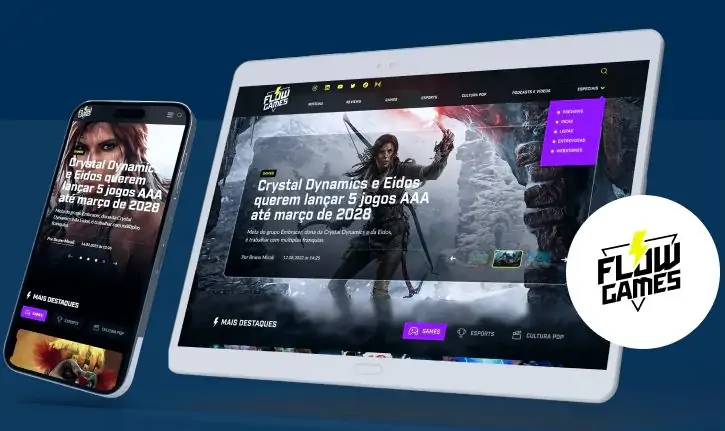
Design of responsive website made by us for our client Flow Games.
Developing a website is a challenging task even for professional web designers. However, you can create an efficient platform with a striking visual identity by following five simple strategies. Here's how and where to apply each one.
While we're on the subject, you may be considering hiring a professional company to create your website, right?
Then make a budget with us quickly and conveniently with our Chatbot by clicking the button below!
1. Prioritize Mobile-First Design for Better User Engagement
More than 80% of the Brazilian population accesses the internet on their cell phones. In other words, anyone who doesn't have a cell phone ready for mobile browsing is missing out on a market with enormous potential.
There are various responsive design for 2025 that make website optimization automatically for mobile devices with different screen sizes.
In general, it's better to invest in a simpler website design for mobile devices. A design with too many elements can worsen mobile navigation, making the site confusing and unintuitive.
It is also preferable that features such as menus are optimized to simplify navigation.
Thanks to the numerous online tools aimed at website design, you no longer need to be a professional in the field to create a responsive website, It's thought-provoking and efficient.
2. Go for Simplicity: The Power of Minimalist Website Design
According to recent studies, Internet users don't spend more than 20 seconds on a page if they can't find what they want. Most decide to leave the page within the first 8 seconds.
You need to create a good impression quickly, with effective web design that communicate your message and offer your product in a clear and simple way.
This means that a visitor needs to be able to find out all about your brand or product, without navigating around the site. Naturally, you want your customer to explore the site, but as most visitors will leave within the first few seconds, make sure your message is clear even to them.
In addition, avoid accumulated or cluttered content anywhere on the screen. Keep empty spaces between one piece of content and another so that they can all be read easily. web accessibility.
Finally, choose photographs and artwork that reflect your values and reinforce your brand, always keeping in mind the simplicity of website design.
3. Use Color Psychology to Influence Visitor Behavior
One modern look for websites you need to take color psychology into account. In fact, the right colors can help close many deals.
It's a fact that many consumers decide whether or not to buy a product based on its aesthetic appearance. What's more, for many of these consumers, the color of the product is a determining factor in their choice.
Color psychology is a field that studies the potential of colors to arouse certain sensations, affections and desires.
Several authors have already worked out palettes and color wheels, with specific emotions for different shades of blue, green and red. Naturally, color psychology is not an exact science, but it can guide your choices when creating a website design.
Combining colors can be a difficult task for some. Fortunately, there are online tools for that too.
You can consult websites that suggest harmonious combinations of different palettes and which of them are complementary to each other. This makes it easier to choose color combinations that are pleasing, rather than shocking or confusing.
4. Adopt F-Layouts to Improve Reading and Navigation
When choosing the alignment of the text on your blog or website, avoid justified alignment. Despite the uniformity this alignment gives to the lines, reading this content can be confusing on smartphones, for example.
This is because people reading while on the move may find it difficult to move from one line to the next, as they are all the same.
For this reason, one of innovations in website design includes aligning all text to the left. This alignment also allows for faster reading, as readers can read only the first few words of each line, finding the content they want more quickly.
In other words, the reading follows an F format, where the first lines are read horizontally and the rest are read almost vertically.
This formatting also avoids other problems common to justified alignment, such as words spaced too far apart or too close together, depending on the number of words per line.
Not with left alignment: the words are more or less the same distance apart and as each line is a different size, it's easier to switch from one to the other.
5. Optimize Site Speed to Reduce Bounce Rates
Create a site structure that is clear, fast and inviting is no easy task. However, it is necessary to invest in optimization of layout for conversion, if you don't want your visitors to leave your content behind.
Sites that take too long to load, for example, are penalized in Google searches and frustrate visitors quickly. Use technology and website design up-to-date and efficient.
Your website needs to be as responsive on both mobile devices and computers. To do this, the elements of the site, such as images and messages, need to be suitable for different screen sizes.
To maintain a good navigability and not irritate your customers, avoid including pop-ups on your pages, as they require additional actions from the reader and can impair both reading and browsing speed.
How Do You Know If Your Website Design Is Right?
To create a successful website, It's not enough just to put it up. You need to carry out regular performance analyses, measuring factors such as navigability on smartphones and tablets, page load times and traceability problems.
When analyzing your site, you should do a SEO audit, identifying possible problems and suggesting new approaches.
Also check the content of your pages, whether they promote your brand's interests, whether they are easy to read and whether they use the best keywords organically.
The quality of content is a crucial factor in gaining visibility on Google. Content of poor quality, with artificial repetition of keywords and difficult scannability usually falls to the bottom of the search results.
Another key factor for search engines and visitors is user experience (UX). This criterion analyzes whether your page offers an intuitive and efficient interface, guaranteeing good navigation for users. In UX Design this translates into clean layouts, consistent design elements, and functionalities that are easy to understand and use.
Finally, don't forget to keep track of your page's traffic indicators, such as the number of visitors, the most and least visited content, and the average length of stay.
Conclusion
In a country where almost 90% of the population accesses the internet regularly, If you're not online, it's almost like you don't exist in the eyes of your audience.
The good news is that anyone can create an attractive and relevant website with templates and online editing tools.
However, creating a website that meets your brand's interests and gains visibility on Google requires dedication and care.
Frequently Asked Questions
Why is it important to have a mobile-first design for my website?
A mobile-first design is crucial because more than 80% of the Brazilian population accesses the internet on their cell phones. Focusing on mobile optimization ensures that your site is accessible and easy to navigate on smaller screens, which improves the user experience and increases engagement.
How can color psychology influence the behavior of visitors to my site?
Color psychology studies how different colors can evoke emotions and influence behavior. Using colors strategically can help attract visitors' attention, convey brand identity and encourage specific actions, such as purchases or sign-ups. Choosing the right colors can increase the effectiveness of your website and improve conversion.
What are the advantages of adopting a minimalist design?
As advantages of having a website minimalist design helps to create a clean and clear user experience, making it easier to navigate and understand the content. With fewer visual elements, visitors can better focus on essential information, reducing cognitive overload and increasing information retention. This can also improve page load times.
How do I know if my website design needs a redesign?
Indications that your site needs a redesign include navigation problems on mobile devices, poor responsiveness, outdated tools and an outdated visual identity. Carrying out regular SEO audits and performance analyses can help identify areas for improvement. Usability problems, negative user feedback and poor performance in search results are also signs that it's time to consider a redesign.

Lucas Pelisari
Lucas Pelisari has been an SEO and content specialist at UpSites for over 6 years, working on the creation and optimization of digital strategies focused on lead generation and organic growth.With experience in website development projects, on-page SEO and link building, he works directly on structuring content and pages aimed at positioning on Google and acquiring qualified traffic.Throughout his career, he has worked on projects for companies such as Kommo, Aldanth, Physical Care, In4, Design.com, Adaptive, Clipto and YeSim, as well as several other clients served by UpSites.He works on projects in different niches, including technology, SaaS, services and local businesses, with a focus on performance, conversion and scalability.Her work is directly linked to lead growth and increased organic visibility, with projects that have seen consistent traffic gains after implementing SEO and content strategies.His content covers topics such as professional website creation, SEO, page structure, performance, user experience and digital growth strategies, always with a practical approach based on real market scenarios.Professional networks:LinkedIn: https://www.linkedin.com/in/lucas-widmar-pelisari-78920033/Instagram: https://instagram.com/lucaswidmar
See all posts


 Calculate Price Now