

20 tactics to increase your website's conversion in 2026
Summary (TL;DR)
In this post, we'll cover 20 practical tactics to increase your website's conversion rate in 2026, ensuring that you attract and retain more customers.
We'll explore strategies such as analyzing the conversion funnel, using heat maps to identify gaps, simplifying the user experience and interface (UX and UI) and the importance of offering strong, personalized CTAs.
We'll also discuss how mobile optimization and the use of A/B testing can positively impact your conversion rate, allowing for constant adjustments and effective improvements.
We highlight the importance of customer-focused actions, such as offering real-time support with live chat, sending emails to recover abandoned carts and simplifying the check-out process.
Finally, we cover how using local SEO, implementing an FAQ section and promoting user-generated content can inspire trust and improve the overall customer experience. With these strategies, you'll be ready to turn visitors into loyal customers and boost your business growth in 2026.

The ultimate goal of any company is to convert and retain its customers. A conversion refers to any desired action taken by the customer. For example, if someone opts in to your email marketing, that's a conversion. If someone buys something on your platform, that's also a conversion. With this in mind, we've brought you 20 tactics to increase your website's conversion in 2025.
It's clear from these examples that without conversions it's impossible to run a business. Unfortunately, conversion optimization is one of the most problematic aspects of running a business.
Today we're going to simplify things for you by listing 20 tactics that will increase your conversion rate in 2025.
20 tactics to improve your conversion rate
Analyze your conversion funnel
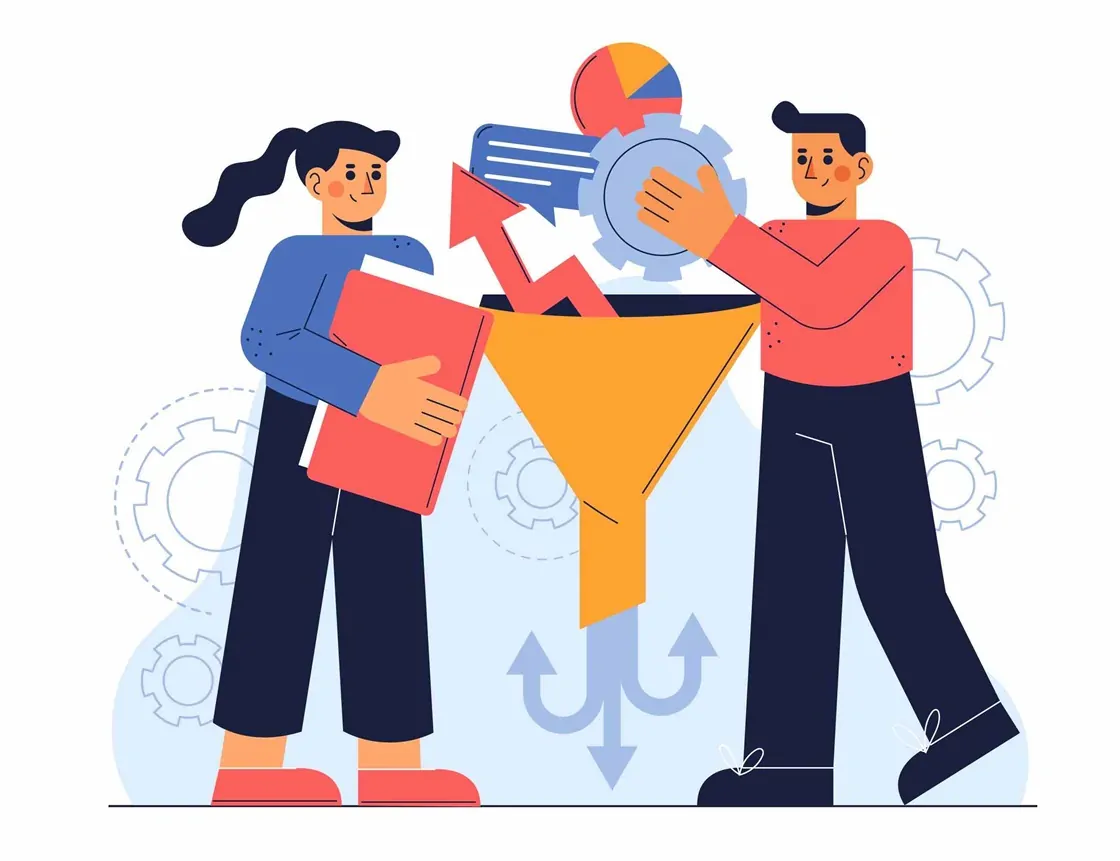
A conversion funnel is the journey your customers take to convert. The journey begins the moment they get to know your brand and ends with signing up or completing a purchase.
The better your conversion funnel, the better your conversion rate. To analyze your conversion funnel, you have to go through it yourself. To do this, follow these steps.
- Research your brand online.
- Go to the first page that appears.
- On the page you have accessed, try to complete a purchase.
- Look at all the pages and steps you have to follow to complete the purchase.
Going through the process will help you notice any problems and frictions. Once identified, you can start working to correct these problems and improve your conversion funnel.
Check the heat maps on the site
A heat map of the site shows where your audience is clicking. The areas that receive the most clicks are red or orange, while the areas with the fewest clicks are blue or green. You can check your site's heat map with specific tools.
Heat maps allow you to see whether your CTAs, conversion buttons and links are being clicked on or not. If the heat map shows that the parts of your pages that lead to conversions are legal, then there's a problem.
You need to assess why these areas are not attracting customer attention.
Sometimes the heat map shows that clicks are high but conversions are still low. This is also cause for concern because it means that something is wrong in the next steps of your conversion pipeline and it's not working as expected.
So analyze these patterns to find flaws and correct them to improve your conversion rate.
Simplify UX and UI
A user experience and the user interface are among the biggest helps or hindrances to a good conversion rate.
The better the user experience, the greater the chances of converting customers. O layout of your website (UI) and the number of steps a customer has to go through directly determine the user experience.
In an e-commerce platform, a good UX is complemented by the following items.
- One navigation menu easy
- Precise labeling and product segregation
- Good internal search engine
- Availability of product variants on the same page
- Loading all page modules simultaneously
There are other things too, but these are the most important. The point is that the better the UX, the more likely the customer is to commit to a conversion.
Offer frequent deals and discounts
Sometimes customers just need a little incentive to commit to a purchase. A great way to do this is to offer promotions and discounts.
Many customers are often on the fence, just waiting for a good deal to come their way. By offering discounts on your stock, you can get many customers to capitulate and commit to a purchase.
You can make this approach more powerful by offering regular customers exclusive discounts on their wish list items. This will also make your regular customers loyal and attract other customers.
Use strong CTAs
CTA stands for call to action. A CTA can be anything in your website that directly encourages customer conversion. Some common examples of CTAs on modern websites are:
- Registration buttons
- Try Demo“ buttons and their variants
- Pop-ups with offers and exclusives
- QR codes that lead to business
QR codes are particularly interesting because they are very accessible and interesting. Most smartphones have an integrated scanner and desktops can use them for free online QR reader tools.
People are more likely to do something if they are asked. Therefore, a CTA will increase the likelihood of people converting.
Optimize for mobile
Mobile devices are the main platform for browsing the web. Approximately 58% of web traffic comes from mobile devices. So you can be sure that a good portion of your traffic comes from mobile devices.
It is essential that you make adjustments to ensure that customers on mobile devices have as good an experience as desktop users. Therefore, the site must look good, load quickly and not have annoying pop-ups that distract the customer.
The better their experience, the happier they will be. And a happy customer is a customer who converts.

This is an example from our client Viva a Cidade, where we made the 100% website compatible with smartphones. This kind of care really helps people who access your site via cell phones, as they become intuitive and provide a good user experience.
Do A/B tests (to see what works)
A/B testing is a method in which you try different solutions to a problem to find out which is the best. Both solutions are used simultaneously, but in different places.
In optimization In order to increase the conversion rate, you can try A/B tests using different CTAs, changes to the site's interface and even different product descriptions. The solution that performs well should be implemented, while those that perform poorly should be discarded.
Highlight your unique selling proposition right from the start
The unique selling proposition or USP is the special feature or service you offer that your competitors do not.
For example, Domino's had a USP that promised delivery in 30 minutes, or the pizza was free. IKEA sells furniture that needs to be assembled. Their USP is twofold: one is that their furniture is unique because it can be assembled and, secondly, they offer to assemble it for free on delivery.
So find something unique that you can do for your customers and tell them about it right at the start of the conversion funnel.
Do local SEO
Local SEO refers to optimizing your website for a specific region. For example, if your company only operates in New York City, your SEO should reflect this.
Your site should use geographically specific keywords so that when people search for services in that area, your site appears. That way, you'll find more people who really want to buy your stuff, so your conversion rate will increase.
See an example for the term Website creation in São Paulo:
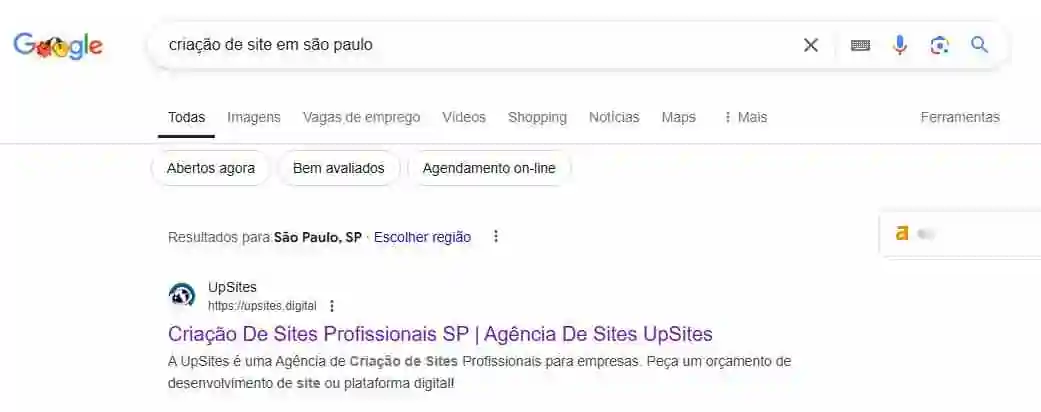
UpSites is in first position for this search. This is important for attracting qualified traffic and converting more sales of our services.
Improve page loading speeds
Page loading speed has a huge effect on conversion rates. Studies show that a page gets more traffic if it loads below 2 seconds. More than that, you'll notice a sharp drop in your traffic.
By optimizing your page loading speed, you can guarantee that no one will get frustrated with your site. Frustrated customers will simply leave and you will lose conversions.
But if everything happens quickly, most customers will see your purchase through to the end and you'll get more conversions.
Use emails to target abandoned carts
Sometimes customers add items to the cart and simply abandon it because the total price is out of their reach. Or they are hesitant and choose not to commit.
You can get more than 50% of these customers to buy something from the abandoned cart if you send them an e-mail. This e-mail should remind them of the cart and you can offer a discount to help them make up their minds.
Start doing this and your conversions will improve a lot.
Provide customer support with live chat
Sometimes customers may have problems browsing your site. For example, they're trying to buy something but the page keeps crashing, or the buy button doesn't work, or they can't pay because the payment processing crashes. Any kind of unforeseen problem can occur.
At that point, they need immediate support. They don't have time to call an agent and wait in line until their call is answered. They also can't send an email and wait a day for a reply.
Then you need to implement live chat. With live chat, an agent can contact them right there and help them with their problem. A positive customer experience with live chat leads to more conversions.
Audit your site to eliminate problems
Site audits are necessary to ensure that everything is working perfectly. Use website audit toolkits to find problems such as:
- Broken links
- Missing pages
- Slow loading
- Orphan pages
Correct them to ensure that your customers have a good experience. A professional website and fully functional also lends credibility to your brand and inspires confidence in your customers. They are therefore more likely to buy from you.
Make sure you have an extensive FAQ section
An extensive FAQ section is a must for more conversions. Sometimes customers have questions about products and their payment and shipping process.
They may also have other questions about your website or brand. Do some analysis of the most searched questions about your brand and create a FAQ about them.
Make sure your customers know about the FAQ page from the start, so they can access it if they need to. FAQ pages also serve to alleviate customer concerns and inspire more confidence in your brand.
The more relaxed the customer is, the better your conversion rates will be.
Avoid returning “No results” in search results
If a customer is searching for a specific product on your site and it doesn't exist or is out of stock, don't show “No results”. Running into a dead end like that is not pleasant and can really take a person's breath away.
Instead, you should humanize your answer. Something like “It seems that this product was not found” works much better. You can also make it worse by showing a similar product.
For example, if someone wants to buy a specific model of hairdryer and you don't have it in stock, suggest a similar model.
In this way, you can often convince customers to settle for an alternative and commit to a purchase. This results in more conversions for you.
Simplify the check-out process
To ensure that customers convert, you need to make the check-out process very simple. If your customers have to go through several steps to finalize their purchase, there is a considerable chance that they will give up on the sale and drop out.
For example, if a customer needs to enter their name, address, telephone number and credit card number, that's fine. Adding a two-factor authentication step is also appropriate. However, adding several authentication steps or requesting email marketing signatures is too much.
If you add several steps like these to get the most out of a conversion, you're more likely to lose the initial conversion altogether. So simplify the check-out process by doing things like:
- Saving checkout information to skip this step next time
- Do not add any extra subscription contracts to the checkout process
- Only request two-factor authentication if the customer is making a purchase in a drastically different region or doesn't follow your usual purchasing patterns. This approach is flexible because it can lead to security problems.
You can use IP location finder tools to check whether your repeat customers are buying products from different regions. It can help you identify fraud attempts and protect your customers from damage.
Don't force emails and marketing messages on customers
One thing every customer hates is feeling forced to do something. If your site is always asking them to do this and that (i.e. an over-saturation of CTAs), they'll get annoyed and leave. Then you'll lose your conversion.
Most of the time, this problem occurs when customers are bombarded with marketing emails and SMS messages. To deal with this, you can make sure that only customers who are interested in your marketing receive these emails and messages.
The best way to do this is to allow customers to accept to receive your marketing messages. The opposite approach is to send marketing messages to all customers by default and allow them to opt out. Don't do this, use opt-in. That way, you won't have dissatisfied and angry customers on your hands.
Answer customer questions about products promptly
Sometimes customers have very specific questions about products that are not answered in the FAQs or product descriptions. These customers have usually had bad experiences with similar products in the past, so they want guarantees.
Here's what you need to do to convert these customers.
- Have a question and answer section on each product page.
- Allow customers to ask questions in this section.
- Answer questions promptly and do your best to eliminate the customer's fears and confusion.
You'll get a lot more conversions this way.
Resource valuations and other types of CGU
E-commerce has become very popular and mainstream, but it brings with it its own set of problems. One of the biggest problems is the inherent distrust customers have in products they haven't seen in person.
They can read the product description and see the photos and videos you've uploaded to the store. However, the lingering thought that media could be tampered with still exists.
However, they can trust the word of other customers who have already bought the product. That's why it's important to share content user-generated reviews, such as customer reviews, on product pages. It's important that these reviews are natural and not bought, as this only serves to increase distrust.
Good reviews will work in your favor, but so can negative reviews. All you need to do is respond promptly to a negative review and try to solve the customer's problem. If you do this, new customers will be less worried and will commit to the purchase more readily.
Make it easy to RMA your products
Sometimes products can be damaged during transportation. It's also possible that a product was defective and was sent by mistake. In these scenarios, don't be stubborn and simply send a replacement or refund the customer's money. The more you insist, the more you damage your credibility.
Sometimes products fail during the warranty period. In such cases, make it easy for the customer to return the product. You can do this by setting up a robust Return Merchandise Authorization (RMA) process.
A strong RMA system has an RMA number that allows customers to return defective products without using their own money. This adds a layer of convenience to the returns process and makes the customer feel more secure. This way, they will also be more comfortable buying from your brand in the future.
Conclusion - Tactics to Increase Conversions
Increasing the conversion rate is one of the most important tasks for any company that wants to grow and stand out in the market. The 20 tactics presented in this article offer practical and proven strategies for optimizing each stage of the sales funnel, from the website design all the way to customer service.
By implementing these actions, you will not only be attracting more conversions, but also strengthening the relationship with your customers, guaranteeing a more satisfying and lasting experience.
Remember: the key is to understand your customers' needs and constantly adjust your strategies to best meet them. 2025 is the time to turn visitors into loyal customers and build a solid foundation for long-term success.
Frequently Asked Questions
What is conversion rate and why is it important?
The conversion rate is the percentage of visitors who take a desired action on your website, such as buying a product, filling in a form or subscribing to a newsletter. It is an essential metric because it measures the success of your marketing and usability strategies, directly impacting your business's return on investment (ROI).
What are the main factors affecting the conversion of a website?
The main factors include: user experience (UX), clarity of design and user interface (UI), website loading speed, effectiveness of CTAs (call-to-actions) and optimization for mobile devices. Other aspects, such as brand reliability and clear policies, also directly influence conversions.
How to identify problems in the conversion funnel?
You can identify problems in the conversion funnel by analyzing data such as abandonment rates at specific stages, carrying out A/B tests and using tools such as heat maps to understand user behavior. Simulating the customer journey also helps to identify friction and obstacles that need to be corrected.
Which tools can help optimize a site's conversion?
Tools such as Google Analytics, Hotjar (for heat maps), Optimizely (for A/B testing), and integrated CRMs for marketing automation are excellent for optimizing conversion. They help you monitor visitor behavior, test design variations and create personalized campaigns based on real data.

Lucas Pelisari
Lucas Pelisari has been an SEO and content specialist at UpSites for over 6 years, working on the creation and optimization of digital strategies focused on lead generation and organic growth.With experience in website development projects, on-page SEO and link building, he works directly on structuring content and pages aimed at positioning on Google and acquiring qualified traffic.Throughout his career, he has worked on projects for companies such as Kommo, Aldanth, Physical Care, In4, Design.com, Adaptive, Clipto and YeSim, as well as several other clients served by UpSites.He works on projects in different niches, including technology, SaaS, services and local businesses, with a focus on performance, conversion and scalability.Her work is directly linked to lead growth and increased organic visibility, with projects that have seen consistent traffic gains after implementing SEO and content strategies.His content covers topics such as professional website creation, SEO, page structure, performance, user experience and digital growth strategies, always with a practical approach based on real market scenarios.Professional networks:LinkedIn: https://www.linkedin.com/in/lucas-widmar-pelisari-78920033/Instagram: https://instagram.com/lucaswidmar
See all posts

 Calculate Price Now