

7 Signs that your current website is holding back your company's growth
Summary (TL;DR)
If you notice signs that your current website is holding back your company's growth, it's time to take action. Problems such as slowness, lack of SEO, outdated design and low conversion have a direct impact on your results. With strategic adjustments, your website can become a real opportunity-generating tool. Check out the details and find out where to start.

Quick access
- 1. slow loading (low performance)
- 2. Not responsive (bad on mobile)
- 3. Outdated and amateurish design
- 4. Low conversion rate (doesn't generate leads/sales)
- 5. Difficult and disorganized navigation
- 6. Low positioning on Google (lack of SEO)
- 7. Outdated or irrelevant content
- Why do these problems hinder a company's growth?
- How can you improve your website to unlock company growth?
- Is your website the engine or the brake on growth?
A website is not just a digital business card, it is a vital strategic tool for attracting, converting and retaining customers. Identify signs that your current website is holding back your company's growth is essential because, in Brazil, around 86 % of households already have access to the internet, which shows how central the digital environment is in consumers' purchasing journey and in their relationship with brands today.
If your website isn't prepared for this scenario, your company could be missing out on business opportunities, lead generation and visibility in the digital market.
Before thinking about complete overhauls or migrations, it's worth checking out the following signs: they help diagnose points that may be limiting results, frustrating users or driving away potential customers before they even have contact with your value proposition.
1. slow loading (low performance)
One of the most noticeable impacts of a website that slows down a company's growth is the slow loading of pages.
In addition to alienating the user practically on first contact, loading speed is one of the factors that search engines consider for rankingSlow sites tend to appear lower in search results, reducing organic visibility.
In a world where attention is a scarce resource, every second counts, users expect pages to load quickly, and when they don't, the bounce rate goes up and your company loses traffic, engagement and potential conversions.
2. Not responsive (bad on mobile)
Another clear sign that your website is hampering growth is when it doesn't work well on cell phones or tablets.
A responsiveness, ability to adapt to the visitor's screen and context of use, This is essential for offering a good user experience, and is also a ranking criterion for search engines.
In Brazil, a growing portion of the population accesses the internet mainly through mobile devices, with recent research indicating that internet access exclusively through cell phones reaches around 65 % of the Brazilian population. .
When a website doesn't adapt its layout, menus and content for smaller screens, it not only loses traffic, it loses relevance and digital competitiveness.
3. Outdated and amateurish design
The look of your website communicates long before the text. A outdated design, out of step with the market or with an amateurish appearance conveys a lack of professionalism and can undermine the visitor's trust in a matter of seconds.
In a competitive digital environment, credibility is decisive, and often the website redesign is essential.
If the layout doesn't reflect the quality of your product or service, the user tends to associate the negative experience with your brand. This stifles growth because it reduces the perception of value, alienates potential customers and hinders any digital marketing strategy that relies on authority and a solid image.
4. Low conversion rate (doesn't generate leads/sales)
If the site receives visitors, but does not generate leads, quotes or sales, There is a strategic problem. A low conversion rate usually indicates flaws in the value proposition, CTAs, page structure or even the user experience.
A website needs to be designed to lead the visitor to a clear action - filling in a form, requesting an offer, buying a product.
When this doesn't happen, traffic becomes waste. And waste, in digital, means investment that doesn't return. This is one of the most critical signs that the website is limiting the company's growth.
5. Difficult and disorganized navigation

A site with confusing menus, too much information or a disorganized structure generates immediate frustration. Visitors should not “look too hard” for what they need, he expects to quickly find services, contacts, differentials and relevant information.
When navigation is not intuitive, the user leaves the site before even understanding its purpose.
In addition, a poorly structured architecture is detrimental to SEO, as it makes it difficult for search engines to index it properly. The result is less visibility, less permanence and fewer conversion opportunities.
6. Low positioning on Google (lack of SEO)
If your site doesn't appear in Google's top positions, it practically doesn't exist for those who are searching solutions in your segment. SEO (Search Engine Optimization) is the set of strategies that optimize pages so that they are found organically in search engines.
This is done with technical structure, keywords, speed, internal links, authority and relevant content.
When the site is not optimized, it loses visibility, receives less qualified traffic and relies exclusively on paid media. In the long term, this limits growth and increases the cost of customer acquisition.
7. Outdated or irrelevant content

Contents old, superficial or misaligned with the reality of the market conveys carelessness. As well as damaging the company's image, it also has a direct impact on Google's ranking, which prioritizes updated and relevant pages.
Incorrect information, services that no longer exist or outdated data generate insecurity and can drive away business opportunities.
A website needs to evolve along with the company. Otherwise, it stops being a strategic asset and becomes just a forgotten shop window.
Why do these problems hinder a company's growth?
All these factors directly affect strategic business indicators. One len websiteto, disorganized or poorly positioned tends to present high bounce rate, which is when the user enters the page and leaves without interacting or navigating to other sections.
This means that the visitor didn't find enough value to continue. The higher the bounce rate, the lower the conversion potential.
What's more, structural problems reduce sales, waste marketing investment and damage the brand's reputation.
There's no point investing in ads, social media or campaigns if the site doesn't support the user experience. It needs to convert, convey trust and strengthen the company's authority. Otherwise, growth stagnates, even with effort and investment.
How can you improve your website to unlock company growth?
If you've identified any of the above problems, the good news is that there are solutions. Improving a website doesn't just mean “making it prettier”, but making it more strategic, technical and results-oriented. Here are 10 practical steps to turn your website into a real growth engine:
1. Optimize loading speed
Speed is a critical factor for user experience and ranking on Google. Small delays already impact the bounce rate. To improve:
- Compress images (preferably in WebP);
- Reduce unnecessary scripts and code;
- Use cache and CDN;
- Choose quality hosting.
A fast website improves retention, increases dwell time and favors conversions.
2. Make the 100% site responsive
More than 80% of internet accesses in Brazil come from cell phones, according to IBGE data (PNAD Contínua TIC). If your site doesn't adapt to mobile, you'll lose most of your audience. Make sure menus, buttons, texts and forms work perfectly on smaller screens. One responsive design it's not optional, it's a basic requirement for competitiveness.
3. Invest in strategic SEO
SEO is what allows your site to be found by those who are already looking for what you offer. To do this, you need to pay attention to these points:
- Keyword research;
- Optimization of titles and descriptions;
- Correct structure of headings (H1, H3);
- Intelligent internal linkage;
- Relevant and up-to-date content.
Without SEO, your site relies exclusively on paid ads to generate traffic, which can be more expensive and not as effective in the long term.
4. Update the design with a focus on experience (UX)
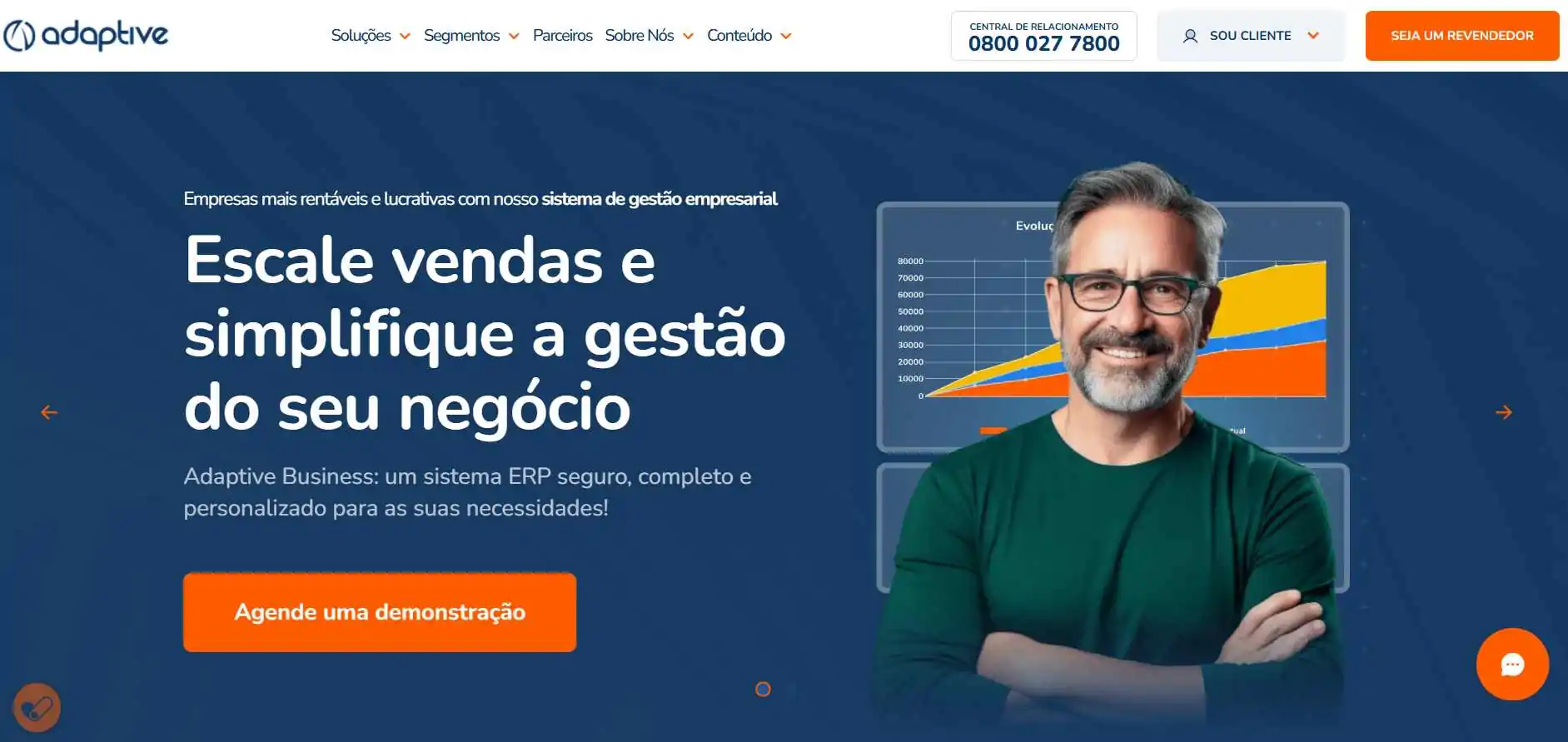
A professional design conveys immediate credibility. Organized visual elements, appropriate typography and a clear hierarchy of information make navigation easier. More than aesthetics, UX is about functionalityThe visitor needs to quickly understand what you do, how they can hire you and why they should trust your company.
Check out the design we created for Adaptive, If you're looking for the best user experience, take a look at how all the elements are designed to provide the best user experience:
5. Simplify navigation
Complex menus and poorly organized pages confuse the user. Structure your site logically, with no more than 6 or 7 main menu items. Example of efficient organization:
Home → About → Services → Cases → Blog → Contact
The simpler the path to conversion, the greater the results in terms of lead generation or sales.
6. Work on social proof and authority
Testimonials, success stories, numbers and certifications increase trust. Studies indicate that consumers are more trusting of companies that display verifiable evaluations. To increasing authority, Include:
- Real testimonials with name and photo;
- Logos of clients served;
- Results obtained;
- Certifications and awards.
Site authority is key to reducing objections during the conversion process and speeding up users' decisions when they enter the site.
7. Create clear calls to action (CTAs)
Many sites don't convert because they don't guide the user. Each page must have a clear objective. Examples of strategic CTAs:
- “Request a quote”;
- “Talk to a specialist”;
- “Download the free material”;
- “Schedule a demo”.
Without targeting, visitors leave without taking action, and that's a big waste. After all, you've already done the work of attracting this audience to your site; letting them escape without interacting with your company is a major structural flaw.
8. Produce relevant and up-to-date content
Content is what attracts organic traffic and educates the market. A well-structured blog helps position your company as a reference. Invest in:
- Educational articles;
- Complete guides;
- Case studies;
- Content aimed at the public's real doubts.
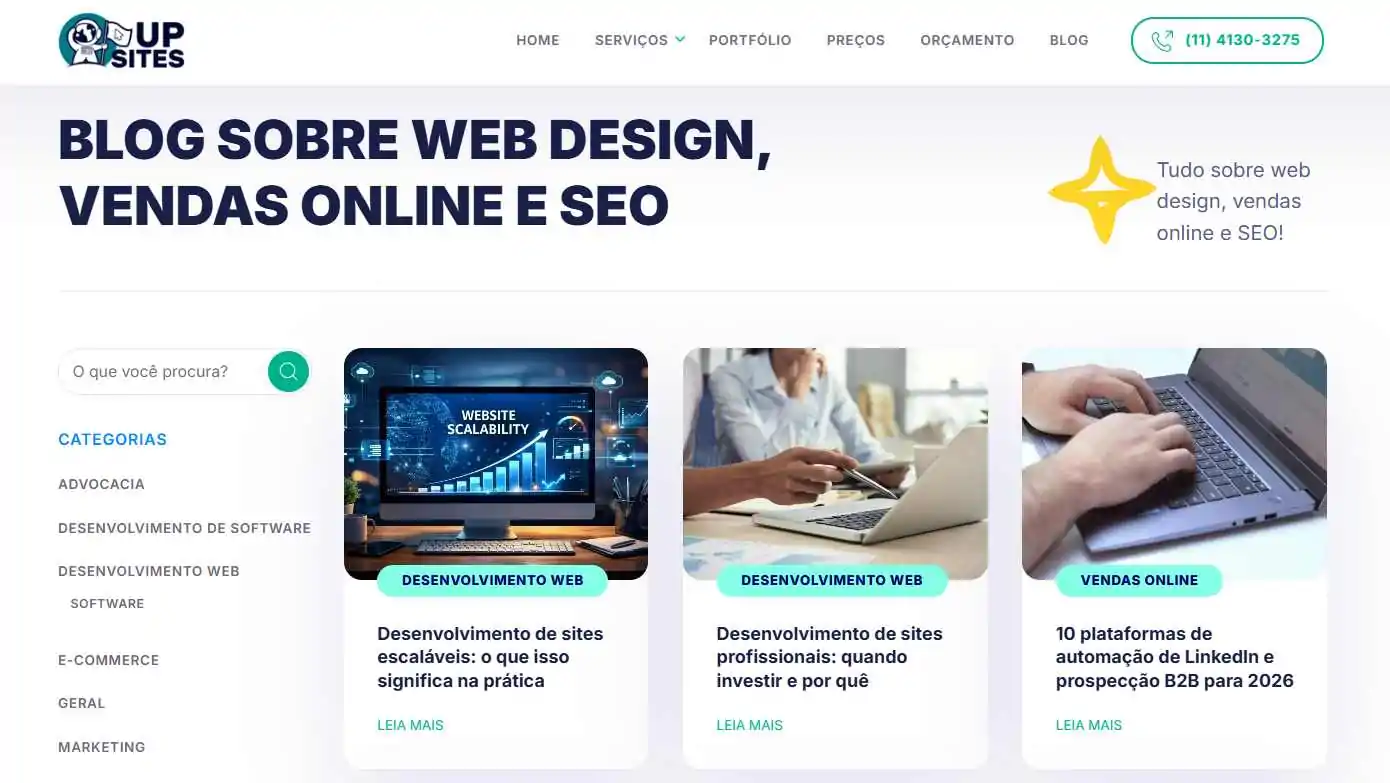
As well as improving your SEO, this strengthens your authority. And it's not complicated at all, just explore your niche and you'll have a blog that's useful and relevant to your target audience, just take a look at our blog:
9. Use data analysis tools
Improvement requires measurement. Tools such as Google Analytics and Google Search Console show data that is essential for adapting strategies and finding opportunities for traffic generation, conversion and more. Check out the most important data for a website:
- Most accessed pages;
- Bounce rate;
- Keywords that generate traffic;
- Points of abandonment.
With data in hand, decisions are no longer based on guesswork but on strategy.
10. Rely on experts for continuous evolution
A website is not a project that ends at launch. It needs constant maintenance, technical improvements, SEO adjustments and optimizations. Companies that treat their website as a strategic asset can grow predictably. Those that “publish and forget” tend to be left behind. To have specialized team makes all the difference in the consistency of the results.
Is your website the engine or the brake on growth?
Identifying the signs that your current website is holding back your company's growth is the first step to changing the situation. Slowness, outdated design, lack of SEO and low conversion are not just technical problems, These are direct barriers to sales, generating opportunities and consolidating the brand in the digital market.
A strategic, fast and well-structured website turns hits into leads, visits into proposals and proposals into sales. If you realize that your digital presence isn't keeping pace with your company, perhaps it's time to evolve and look for professional services for creating and redesigning websites.
Click on the button below and find out how transform your website into a real growth asset:
Frequently Asked Questions
How often should I update my site?
Ideally, you should review your site at least once a year in terms of structure, technology and performance. Content, on the other hand, should be updated more frequently, especially if you work with a blog or strategic SEO pages. Constant updating keeps your site competitive, relevant and in line with changes in the market and user behavior.
Can an old website damage my brand even if it still works?
Yes. Even if it is “live”, a visually outdated or technically outdated website conveys a lack of innovation and can compromise the perception of authority. In competitive markets, the digital image directly influences the purchasing decision, especially when the customer compares you with more modern competitors.
Is it worth investing in improvements if my site is already generating results?
It's worth it, especially if there's room for growth. A website that already converts can become even better with strategic adjustments to UX, SEO and copy. Small improvements can generate significant increases in the conversion rate and the volume of leads, boosting the return on investment.
How do I know if my site has a high bounce rate?
The safest way is to analyze the data in Google Analytics. If the bounce rate is high and the average time on page is very low, it may indicate that the content is not in line with the user's expectations or that there are technical problems, such as slowness and confusing navigation.
Does design really influence sales?
Yes. Studies on digital consumer behavior show that visual credibility is one of the factors that most impact online trust. A professional, organized and intuitive layout increases the perception of value and reduces objections at the moment of decision.
Can a bad website affect paid traffic campaigns?
It can, and a lot. There's no point investing in ads if the landing page is slow, disorganized or unpersuasive. This increases the cost per click, reduces conversion and wastes budget. The site needs to be prepared to receive traffic.
Is it better to redesign the site or create a new one from scratch?
It depends on the current structure. If the problem is only visual or punctual, a site redesign can solve the problem. However, if the technological base is outdated or limited, creating a new website may be more strategic in the long term, avoiding rework and future limitations.
How long does it take to see results after improving the site?
The first technical impacts, such as improved speed and experience, are immediate. SEO results, on the other hand, can take a few weeks or months, depending on the competition and the strategy applied. The important thing is to understand that consistent improvements generate sustainable growth.

Lucas Pelisari
Lucas Pelisari has been an SEO and content specialist at UpSites for over 6 years, working on the creation and optimization of digital strategies focused on lead generation and organic growth.With experience in website development projects, on-page SEO and link building, he works directly on structuring content and pages aimed at positioning on Google and acquiring qualified traffic.Throughout his career, he has worked on projects for companies such as Kommo, Aldanth, Physical Care, In4, Design.com, Adaptive, Clipto and YeSim, as well as several other clients served by UpSites.He works on projects in different niches, including technology, SaaS, services and local businesses, with a focus on performance, conversion and scalability.Her work is directly linked to lead growth and increased organic visibility, with projects that have seen consistent traffic gains after implementing SEO and content strategies.His content covers topics such as professional website creation, SEO, page structure, performance, user experience and digital growth strategies, always with a practical approach based on real market scenarios.Professional networks:LinkedIn: https://www.linkedin.com/in/lucas-widmar-pelisari-78920033/Instagram: https://instagram.com/lucaswidmar
See all posts

 Calculate Price Now