

Scalable website development: what it means in practice
Summary (TL;DR)
The development of scalable websites consists of creating a website that is prepared to grow along with the company, without losing performance or requiring constant rebuilding.
This approach guarantees more flexibility, reduces costs in the long term and supports growth and digital marketing strategies.
Understand how this process works and why it is essential for forward-thinking businesses.
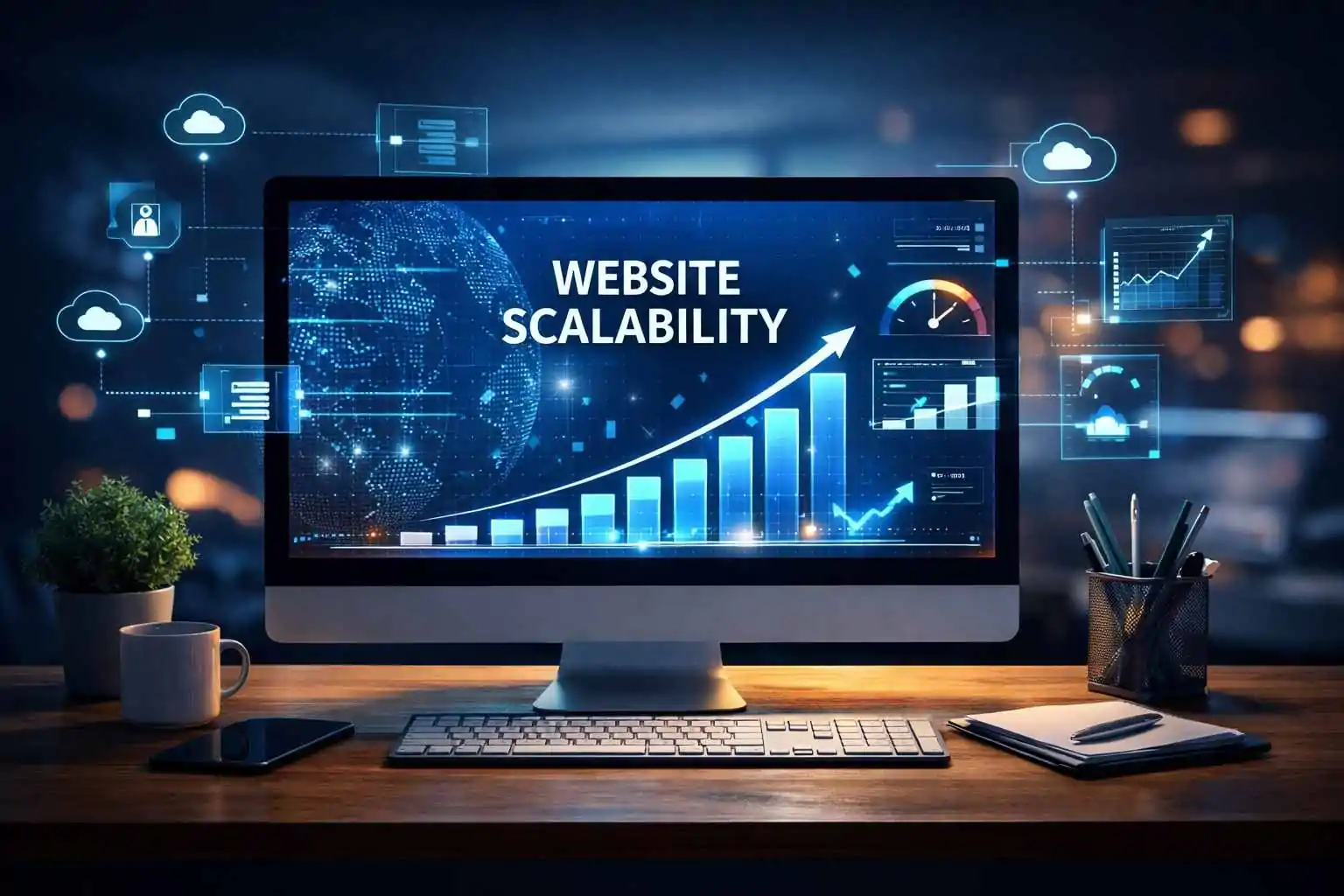
O developing scalable websites means creating a website that is ready to grow along with the company, without having to be redone with each new demand. In practice, this involves thinking about the structure, technology and organization of the project from the outset, taking into account the future size of the business, the increase in access, new functionalities and integrations that may arise over time.
More than just putting a website up, developing with a focus on scalability is making a strategic decision. It means thinking of the site as a digital asset that supports growth, marketing, sales and internal processes. Understand what really characterizes a scalable website and why this concept is so important for companies that want to grow in a structured way.
What is a scalable website?
One a scalable site is one that can grow in volume, functionality and complexity without losing performance, stability or quality of user experience. It is designed to support more accesses, new content, integrations and strategic changes, without requiring complete rebuilds at each stage of business growth.
To understand this better, here are the main characteristics of a scalable website:
- Well-planned architecture: organized structure of pages, content and data, facilitating future expansions;
- Flexible technology: use of platforms and frameworks that allow you to add features without technical limitations;
- Good performance: maintains speed and stability even with increased traffic and content, without losing the site responsiveness;
- Ease of maintenance: site updates, adjustments and improvements can be made without compromising the functioning of the site;
- Possible integrations: the ability to connect to external systems such as CRM, ERP, marketing automation and analysis tools;
- SEO ready for growth: structure that supports new pages, categories and content without affecting positioning;
- Adjustable security: allows you to reinforce layers of security as your site grows and gains relevance.
How does scalable website development work in practice?
In practice, the website development A scalable website follows a strategic process that goes beyond the visual and considers technology, structure and future growth. Each stage is designed to avoid technical limitations and allow the site to evolve as the company grows. Check out the main steps in this process:
1. Diagnosis and strategic planning
It all starts with understanding the business, its objectives and its growth projections. At this stage, the company's current size, the market in which it operates and the demands that may arise in the future are analyzed. This diagnosis guides technical decisions and avoids improvised solutions that don't scale.
2. Defining the site's architecture
This is the site structure, These include pages, content hierarchy and navigation flows. A well-defined architecture makes it easier to create new sections, categories and functionalities without compromising organization. This step is essential for scalability and SEO.
3. Choosing the right technology
The technology chosen has a direct impact on the site's ability to grow. Flexible platforms, modern frameworks and solutions widely adopted in the market allow for continuous evolution. Avoiding rigid systems guarantees more freedom for adjustments and future integrations.
4. Modular development
The site is built in modules, i.e. independent parts that can be altered or extended without affecting the whole. This makes it possible to add functionalities, exclusive areas or new services with less technical effort and less risk of errors.
5. Preparing for integrations
Scalable websites are born ready to be integrate with other tools, such as CRM, ERP, automation platforms, payment systems or analytics. This preparation avoids rework when the company decides to professionalize processes or expand its digital operation.
6. Performance and security optimization
During development, good performance and security practices are applied, with the following in mind increased traffic and data volume. This includes code optimization, lightweight structure and protection measures that can be strengthened as the site grows.
7. Tests, adjustments and continuous evolution
After launch, the site undergoes constant testing and gradual improvements. A scalable project is not static: it evolves based on data, user behavior and new business demands, ensuring longevity and efficiency over time.
Why invest in scalable website development?

Investing in the development of scalable websites is a strategic decision for companies thinking in the medium and long term. This type of project avoids technical limitations, reduces rework costs and creates a solid digital base to accompany business growth. Here are the main reasons for adopting this approach:
Sustaining the company's growth
A scalable website keeps up with the increase in access, content and functionality without losing performance. As the company grows, the site continues to function steadily, avoiding crashes, slow loading or the need to redo the entire project. This guarantees continuity and security for the digital operation.
Reducing costs in the long term
Although the initial investment may be more strategic, scalable sites avoid recurring costs for corrections, migrations or complete rebuilds. Each new feature or expansion can be incorporated gradually, taking advantage of the existing structure and reducing waste.
Supporting the digital transformation of the business
A digital transformation requires technological bases that are flexible and prepared for constant change. A scalable website makes it possible to integrate new tools, automate processes and adapt the business model with agility. Without this foundation, digital initiatives end up being held back by technical limitations.
Improving the user experience
Well-structured websites maintain good performance even with increased traffic and content. This ensures fast, organized and intuitive navigation, essential factors for user engagement, conversion and retention over time.
Facilitate SEO and marketing strategies
With a scalable structure, it is possible to create new pages, campaigns, landing pages and content without compromising performance or positioning in search engines. This gives you more freedom for digital marketing actions, organic growth and the application of SEO strategies that make the site convert more organic leads.
Preparing the business for new opportunities
Companies change, markets evolve and new opportunities arise. A scalable website allows you to quickly adapt your positioning, launch new services or operate in new niches, without having to rely on complex or time-consuming rebuilds.
Scalability as the basis for digital growth
Investing in scalable website development means thinking of the site as a long-term strategic asset. When the structure, technology and architecture are planned from the outset for growth, the company gains agility, reduces future costs and avoids technical limitations that hinder the evolution of the business.
If your company is looking to grow in a structured and secure way in the digital environment, the UpSites can help a building a website prepared for today and the future.
Click on the button below to get a quick and optimized quote:

Frequently Asked Questions
What happens if a site isn't scalable?
When a website is not scalable, it begins to present limitations as the company grows. Problems such as slowness, difficulty in adding new pages or functionalities and excessive dependence on technical adjustments are common. Over time, this leads to rework, extra costs and can even prevent the business from evolving in the digital environment.
Are scalable websites only suitable for large companies?
No. Scalable websites are also highly recommended for small and medium-sized businesses with growth plans. By investing in a prepared structure from the outset, the business avoids having to redo the site at each new stage. This brings more predictability, savings and security to the company's digital future.
Does a scalable site take longer to develop?
Development may require more careful initial planning, but this does not mean significant delays. In practice, this extra time is offset by the reduction of problems in the future. A well-planned website avoids constant corrections, facilitates maintenance and speeds up the implementation of new functionalities over time.
Is it possible to make an old site scalable?
In some cases, yes, especially if the site already uses flexible technologies. However, when the structure is too rigid or outdated, adapting can be more expensive and less efficient than redoing. For this reason, a technical analysis is essential when deciding whether to evolve the current site or start a new project.
Are scalable sites more expensive?
The initial investment may be a little higher, but the total cost over time is usually lower. Scalable sites reduce the cost of rework, emergency migrations and structural corrections. In addition, they allow growth to happen gradually, taking advantage of the base already built.
Does scalability impact SEO?
Yes, directly. A scalable website makes it easier to create new pages, categories, content and internal links, essential elements for SEO. In addition, well-organized and performant structures tend to offer a better user experience, a factor that is increasingly relevant for search engines.
Which technologies are most used in scalable websites?
Scalable websites generally use flexible technologies that are widely adopted in the market, such as well-structured WordPress, modern frameworks and modular architectures. The choice depends on the size of the project, the integrations required and the business objectives, always prioritizing ease of evolution.
How do I know if my company needs a scalable website now?
If the company plans to grow, invest in digital marketing, launch new services or integrate systems in the future, the answer tends to be yes. Thinking about scalability from the outset avoids technical limitations and ensures that the site keeps pace with the evolution of the business without becoming an obstacle.

Lucas Pelisari
Lucas is an SEO specialist at UpSites. He has helped several companies climb the google rankings and is always improving his skills. He is also a digital marketing enthusiast and always tries to keep up to date with the digital world.
See all posts


 Calculate Price Now