

10 AI techniques to optimize a website
Summary (TL;DR)
Artificial intelligence is transforming SEO, bringing more precision and agility to every stage of the process. In this article, we'll look at AI techniques for optimizing a website. We'll show you AI tools that help identify strategic keywords, structure complete briefings, produce optimized content, personalize materials, review technical errors and analyze performance data in real time.
In this post we also explain how this technology makes it possible to continuously improve pages, adapt content for voice search and strengthen link building strategies more efficiently. By combining these practices with human supervision, we guarantee quality, authenticity and consistent results, showing why the combination of SEO and AI is one of the most powerful ways to increase visibility, traffic and digital authority.
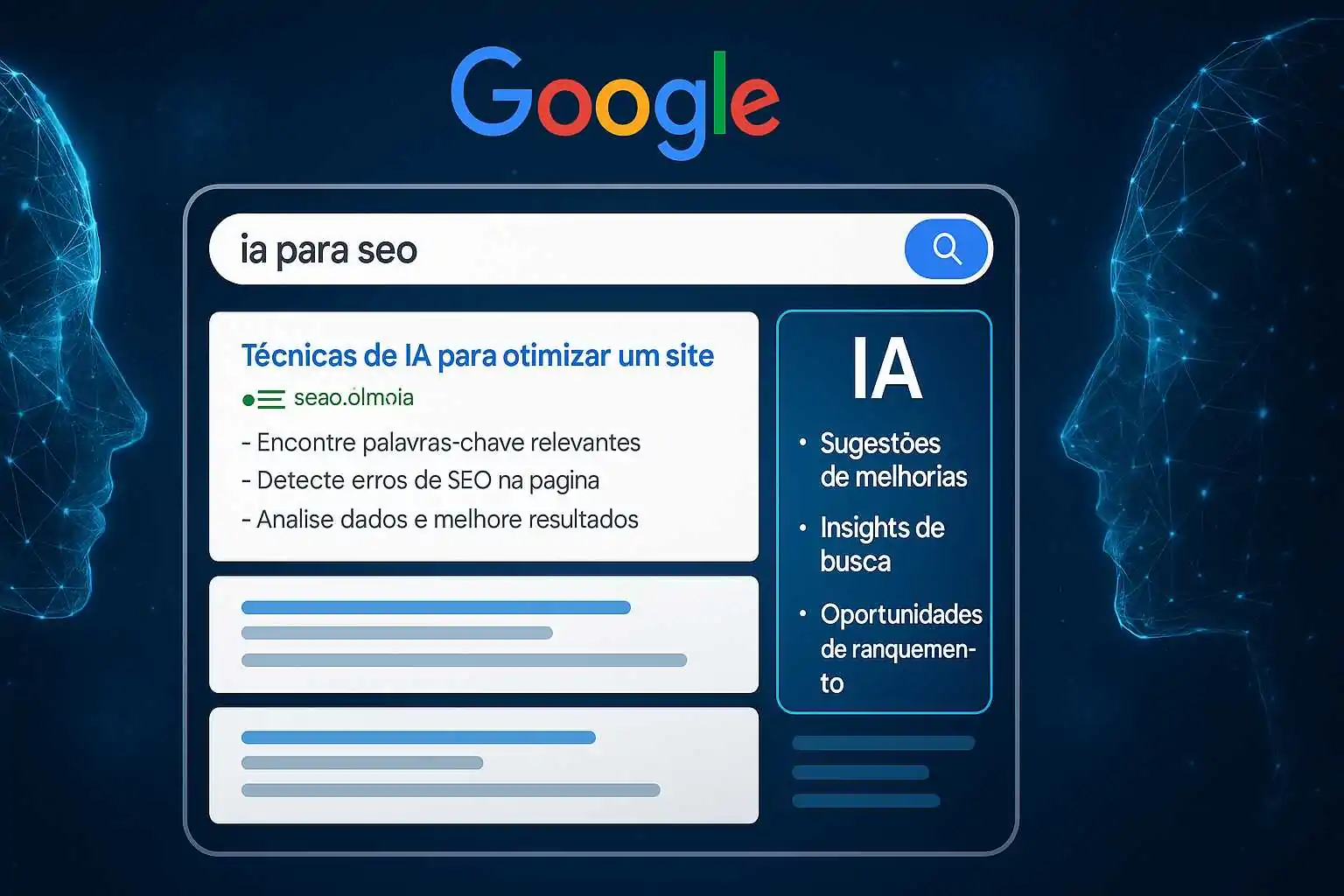
Even with all the changes brought about by smart search engines, organic traffic remains one of the most valuable sources for those who want to grow online. And the truth is, with the AI techniques to optimize a website, This process can be made even faster and more efficient.
Tools based on artificial intelligence help analyze data in real time, suggest content improvements, predict trends and identify ranking opportunities much more accurately. This saves time and directs efforts to what really matters: delivering value to the user and being recognized by search engines as a reliable source.
If you still think that SEO is a thing of the past, it's time to review your concepts. Artificial intelligence hasn't put an end to optimization strategies, The only thing that has changed is the way they are made.
In this article, you'll learn about the 10 main AI techniques that can transform your site's performance and open new doors in the digital world. Check them out below!
What is SEO and how important is it?
SEO stands for Search Engine Optimization<span style="”font-weight:" 400;”>, search engine optimization. This is a set of strategies used to improve the positioning of a website in the organic results of Google and other search engines, without relying on paid ads.
Main SEO techniques:
- Content optimization: create relevant texts, with good keywords and a clear structure;
- Link building: get links from other reliable sites pointing to yours;
- Local optimization: focus on geo-localized searches, ideal for regional businesses;
- Technical optimization (on page): improve speed, code, URLs, sitemap and usability.
Investing in SEO increases your site's authority and attracts more qualified visitors. Various surveys show that users trust organic results more than sponsored ones. In addition, well-positioned sites tend to have a higher conversion rate, as they appear to those who are really looking for that type of solution or service.
AI techniques to optimize a website
AI techniques applied to SEO have become increasingly accessible, offering automation and intelligence to optimize tasks that used to take hours. Today, with just a few commands, it is possible to accelerate from the choice of keywords to content production.
The key is to use these tools strategically, always with human supervision to ensure quality, originality and alignment with the site's objectives.
1. find keywords
Choosing good keywords is the first step to attracting qualified visitors. They are the terms that the public types into Google when they are looking for something. AI can analyze trends, search volume and competition to suggest the best options. Tools such as ChatGPT, They are able to generate segmented lists of keywords for different niches.
For example, if you have a cosmetics store, AI can indicate terms such as “vegan moisturizer for dry skin” or “best sunscreen for oily skin”, which are specific searches with a high potential for conversion.
With this base, it is possible to direct all the content on the site to meet exactly what the public wants, increasing the chances of ranking and visibility.
2. Create briefings
The creation of briefings is an essential stage in ensuring alignment and efficiency in creative processes. And AI can help a lot here. Based on keywords, personas and page objectives, AI tools can generate detailed briefings in just a few minutes. This facilitates communication with copywriters, designers and developers.
Imagine that your team needs to create a blog post about “summer fashion trends 2025”. With the help of AI, it is possible to put together a briefing with text structure, suggested topics, tone of voice, target audience and even image suggestions.
The same goes for videos, landing pages and even ad campaigns. With a good brief, production flows faster and with less rework.
3. Produce optimized content
AI can also accelerate creation of SEO-optimized content, The content should be compelling, with attractive titles, magnetic introductions and even complete paragraphs with strategic use of keywords. Of course, ideally this content should always be reviewed by someone on the team to ensure quality, authenticity and connection with the brand's identity.
For example, when using AI to write a story about “benefits of content marketing”, She can structure the main points, suggest intertitles and deliver a basic text ready for editing.
This saves time and helps maintain the frequency of publication - one of the factors that Google considers for ranking. With constant and well-structured content, the chances of reaching the top positions increase significantly.
4. Make personalized materials
Artificial intelligence can be used to create rich, personalized materials, These include eBooks, infographics, spreadsheets and interactive tables based on the profile of the target audience. These pieces serve as digital lures, strengthen the site's authority and help attract leads. What's more, they deliver real value, with relevant content tailored to the interests of those who visit the site.
For example, with a few commands, you can use AI to generate an eBook with practical tips on financial organization, an infographic with industry statistics or even an automated spreadsheet for task control.
The difference lies in personalizationAI makes it possible to adapt the format and content according to the user's behavior and the brand's objectives, making the experience much more efficient.
5. Detect and correct errors
AI is also a great ally when it comes to review content and detect errors that can harm a website's performance. It can identify grammatical flaws, spelling problems, broken links and even repetitions or poorly organized structures that affect readability and ranking in search engines.
As well as finding problems, AI can also suggest improvements. For example, if a page is poorly ranked, the tool can indicate a lack of heading tags, too many keywords or no meta description.
This makes the proofreading process much faster and more effective, raising the technical and editorial quality of the site with minimal manual effort.
6. Analyze the data and results
Another powerful technique is the use of AI to interpret data and generate intelligent reports on site performance. Based on integrated tools, artificial intelligence can cross-reference traffic information, user behavior, the origin of accesses and conversions to deliver accurate and valuable insights.
For example, instead of just presenting numbers, AI can show that a landing page has a high bounce rate because it is slow or has a confusing layout. Or it could indicate which content performs best and which should be optimized.
This way, you can make strategic decisions based on real data, without having to analyze everything manually.
7. Keep improving
One of the biggest advantages of artificial intelligence is ability to suggest continuous improvements based on data. By monitoring the site's performance and analyzing user behavior, the AI pinpoints pages with poor performance, content that needs to be updated and even opportunities that have not yet been explored.
This process of continuous improvement is essential to keep the site competitive. Instead of waiting for a drop in traffic or a technical problem to arise, AI anticipates the necessary adjustments and allows quick action to be taken. This ensures that the site constantly evolves, keeping up with changes in algorithms and user behavior.
8. Translate content quickly
AI can also be used to translating content quickly and with good quality. This is especially useful for companies that want to reach international audiences or expand their presence in other regions of the country. With automated tools, you can translate articles, pages and even eBooks in seconds.
In addition to speed, AI has come a long way in understanding contexts and idioms, which increases the naturalness of the translated content. Although human proofreading is still important, AI drastically reduces the time needed to create multilingual versions of your website and extend your brand's reach digitally.
9. Optimize for voice search
With the growing use of virtual assistants such as Alexa, Google Assistant and Siri, optimize the site for voice search has become essential. AI can help adapting content to this new form of search, by suggesting more conversational phrases and focusing on direct questions that users usually ask.
According to recent data, more than 60% of Brazilians already access the internet on their cell phones, and many use voice commands instead of typing. This reinforces the importance of producing objective content, with quick responses and natural language, making it easier for search engine AI to recognize and indicate your site as a reliable source.
10. Create a link building strategy
AI can help create link building strategies, It analyzes which sites are relevant to your niche and suggests opportunities for partnerships, guest posts or citations. Based on your content and keywords, it identifies where it's worth getting backlinks to increase your site's authority.
In addition, AI helps to monitor incoming links and check that they are active and performing well. This saves time and avoids common mistakes such as broken links or poor quality links. With a good link building guided by AI, it is possible to significantly improve the site's ranking in organic results.
The future of SEO has already begun
With so many possibilities, it's clear that AI techniques to optimize a website are no longer a distant trend, but an accessible and strategic reality. Using these tools with intelligence and critical vision can transform the way your website positions itself, communicates and converts.
If you want to apply all this safely and efficiently, click on the button below and talk to us.and the UpSites team to make a consulting SEO specialized that will take your project to the next level.
Get a quote
Frequently Asked Questions
Is artificial intelligence replacing traditional SEO?
No. AI does not replace SEO, but complements it. It speeds up analysis, suggests keywords and creates optimized content, while traditional SEO guarantees strategy, quality and focus on the user.
Which SEO tasks can be optimized with AI?
AI helps with keyword research, briefing creation, content generation, technical review, data analysis and even identifying link building opportunities.
Does using AI in SEO guarantee better results on Google?
It doesn't guarantee it on its own. AI offers speed and insights, but human supervision is needed to validate data, maintain originality and align content with brand objectives.
Is it safe to use artificial intelligence to produce content?
Yes, as long as the texts are proofread and adapted. AI helps with structuring and optimization, but human proofreading is essential to avoid errors, repetition and quality problems.
Is it worth investing in AI-supported link building?
Yes. AI makes it easier to identify relevant sites, monitor backlinks and analyze opportunities. However, negotiation and curation must be carried out by experts.

Lucas Pelisari
Lucas Pelisari has been an SEO and content specialist at UpSites for over 6 years, working on the creation and optimization of digital strategies focused on lead generation and organic growth.With experience in website development projects, on-page SEO and link building, he works directly on structuring content and pages aimed at positioning on Google and acquiring qualified traffic.Throughout his career, he has worked on projects for companies such as Kommo, Aldanth, Physical Care, In4, Design.com, Adaptive, Clipto and YeSim, as well as several other clients served by UpSites.He works on projects in different niches, including technology, SaaS, services and local businesses, with a focus on performance, conversion and scalability.Her work is directly linked to lead growth and increased organic visibility, with projects that have seen consistent traffic gains after implementing SEO and content strategies.His content covers topics such as professional website creation, SEO, page structure, performance, user experience and digital growth strategies, always with a practical approach based on real market scenarios.Professional networks:LinkedIn: https://www.linkedin.com/in/lucas-widmar-pelisari-78920033/Instagram: https://instagram.com/lucaswidmar
See all posts


 Calculate Price Now