

SEO techniques: how to boost your organic traffic
Summary (TL;DR)
In this post, we'll talk about the main SEO techniques that can help boost organic traffic and improve the positioning of websites in search engines.
We discussed the importance of improving titles and descriptions to increase CTR, using internal links, updating old content, looking for content opportunities with low competition, correcting content gaps, and taking advantage of competitors' dead pages to build links.
These strategies aim not only to improve ranking, but also to increase visibility and engagement with the target audience.
The demand for SEO consultancy has been getting bigger and bigger and there is a reason for this: without website optimization, If a company does not appear on Google. That's why UpSites has decided to share with you the main SEO techniques.
In fact, it may even appear, but not on the first page, which practically means that it isn't appearing, since users don't usually move on to the second page of search results, let alone the next ones.
And if you want to position your site on the first page of Google, there is a list of SEO techniques that you need to apply, however, many of them end up being presented in a very vague way, such as:
- Write great content;
- Create backlinks;
- Use meta titles, etc.
In this post, we'll focus on SEO techniques that boost organic traffic and can generate great results.
Let's go!
Suggested SEO techniques
We know that, in theory, SEO is very simple. site optimization for search engines. However, in practice, SEO techniques can generate many doubts.
With that in mind, here's a list we've created with some tips on great SEO techniques for you to apply this year.
1. improve titles and descriptions to increase CTR
If you think that SEO is just about ranking, we need to tell you that this is not how it works.
Let's say you're in first place with a keyword that has thousands of monthly searches. You won't get traffic unless people actually click on your page in the search results.
That's why it's important to optimize for clicks. But how do you do it?
Two main things can affect your click-through rate (CTR):
- Title tag
- Meta description
This is how they both appear in search results:

Image from www.ahrefs.com
They are what will catch the user's eye and make them click on the link or not. So you need to make them as attractive as possible:
- Making your title clear;
- Creating a URL friendly;
- Demonstrating a clear benefit;
- In line with the intention of the research.
But there's something you need to know: no matter how hard you try to get it right, things don't always work out. That's because sometimes people simply don't click on your website in the search results. And therein lies the opportunity:
- Find the keywords for which you rank on the first page;
- Look for those with a low CTR;
- Improve the title tags and descriptions of the associated pages.
You can do this analysis using tools such as SEMRush, Google Keyword and Ahrefs Site Explorer.
2. Boost underperforming pages with internal links
The internal links are backlinks from other pages on the same site. Let's say you're writing a post for your blog. You can insert links from pages on your website or posts that have already been published - as long as they are relevant to the subject.
Why are they important? Because they help the flow of “authority” on your site. Many also believe that internal link anchors (the clickable words with the links) influence Google rankings.
This is something that Google's John Mueller has practically confirmed on a number of occasions.
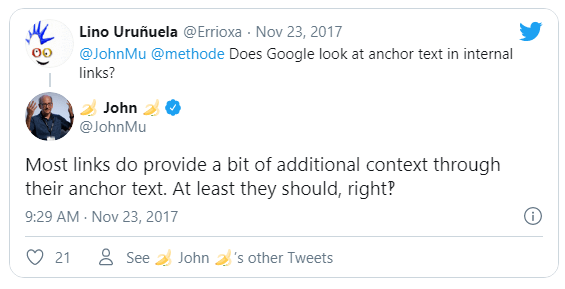
Image from www.ahrefs.com
Now, it's important to note that you should have a good internal link structure to begin with. This means choosing relevant links and using keywords that really make sense.
Imagine you're writing a post about types of paid advertising, but you've already published another post about Facebook Ads. In the post you are writing now, you can insert a topic about ads on the social network and insert the link to your already published post under the keyword “Facebook Ads”.
Try as much as possible to insert at least two or three links, but be careful not to overdo it, after all, they should only be added where they are really relevant.
3. Update the content
Sometimes content that usually performs well on search engines no longer does so.
When you test old content, you may notice that it has seen a big drop in organic traffic. However, if you update this content, you may see an increase in traffic - possibly even more than when it was published.
That's why it's so important to update and republish articles with new information, in addition to SEO updates. The question is: how do you find posts and pages that are likely to benefit from a content update?
a) Use trial and error
You have to deal with this situation, because it happens over time. Therefore, it is usually old posts and pages that suffer from a drop in organic traffic.
If you have the time or a team for it, you can update all your old posts, so you can be sure that they will all be up to date. You can also see which of your old posts generated the most conversions and bet on them.
b) Use Google Analytics
If you are a Google Analytics and prefer to do it more methodically, then you can use the tool to help you. Below, you'll find a method for locating these pages on a large scale.
To get started, go to Google Analytics and navigate to the landing pages. Then set your period to the most recent full 12 months (e.g. January 1, 2018 - December 31, 2018), filter by organic traffic only and add “month” as a secondary dimension. You'll probably see something like this:
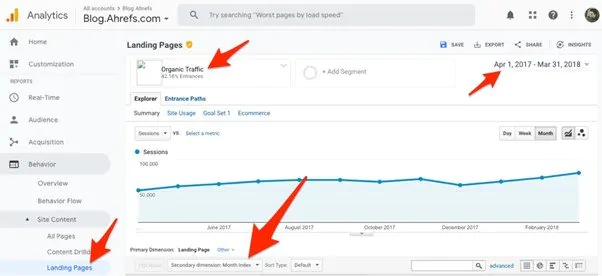
Image from www.ahrefs.com
Export the report as a CSV. Then set up a spreadsheet to compare the number of visits in the best month with the visits in the last month. It will look something like this:
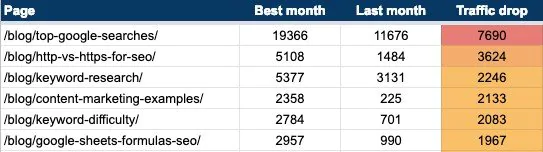
Image from www.ahrefs.com
This way you can see which pages have seen the biggest drop in organic traffic and invest your efforts in updating them.
It's also worth checking the SERP of the primary keyword for each page for signs of updating as a ranking factor. For example, the current year in the titles of the highest ranking pages:
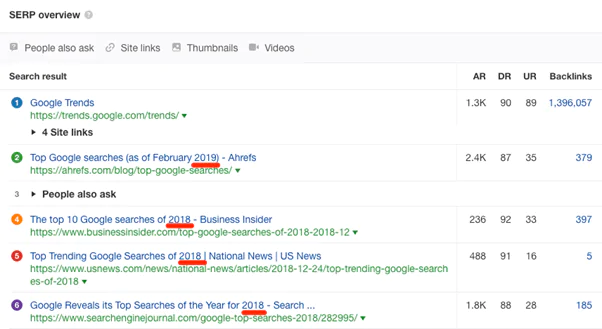
Image from www.ahrefs.com
Or recent publication dates:
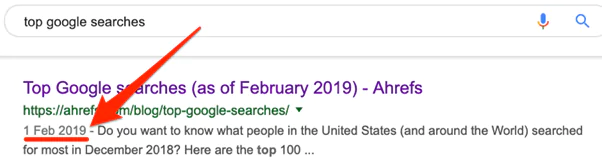
Image from www.ahrefs.com
These things show that Google is prioritizing updated pages in the SERP. And this can increase the likelihood of a content update being successful for that page.
4. Look for accessible content opportunities
Content analysis has shown that the more links a page has, the more organic traffic it is likely to attract. But here's the thing: there are exceptions to this general rule.
Some pages rank and attract tons of search traffic with very few backlinks, or even no backlinks at all. The keywords for which these pages rank are easy to find - in other words, topics for which you rank without many backlinks.
So how do you find these pages?
You can use the Ahrefs Content Explorer. It is a searchable database of over a billion web pages. To use it, enter any word or phrase to see all the mentions on the internet, plus some useful SEO metrics for each result.
Here's an example using “protein powder”:
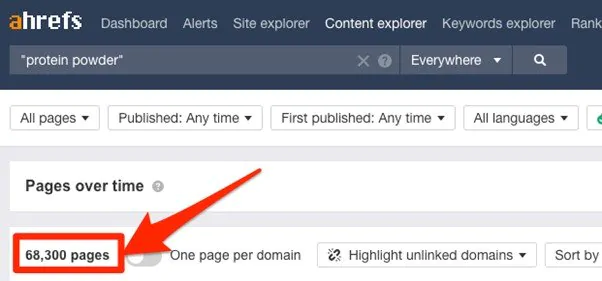
Image from www.ahrefs.com
There are 68,300 pages that mention this phrase! Now, these results will be filtered to find only pages with:
- At least 500 organic visits per month;
- Zero reference domains.
In other words, pages that receive a lot of organic traffic without many backlinks.
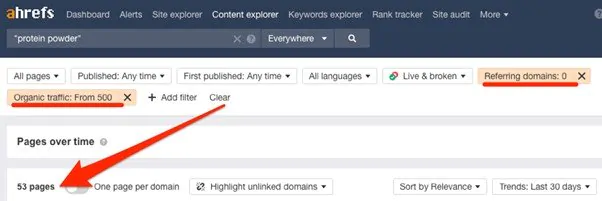
Image from www.ahrefs.com
There are now 53 results, one of which is this page:

Image from www.ahrefs.com
If we check the “Organic Keywords” tab, we'll see that it's ranking for keywords related to protein-rich muffins. And they all have a low score of keyword difficulty.
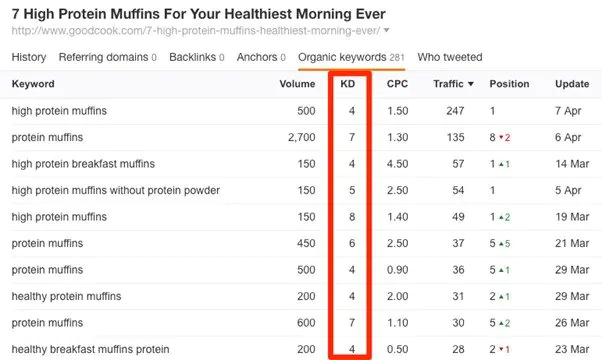
Image from www.ahrefs.com
This almost confirms our theory that this is a low competition topic. So if you have a website related to fitness, this topic could be an easy source of traffic.
5. Clear content gaps
A content gap is when your competitors have content on a topic that you haven't covered yet. But content gaps can also happen at page level.
To find out if a piece of content covers everything it should, you can also use tools to help you, such as the Ahrefs Content Gap, for example. All you have to do is enter the page you want to analyze and some of the best-ranked sites - and competitors - to make a competitive analysis.
Here's an example:
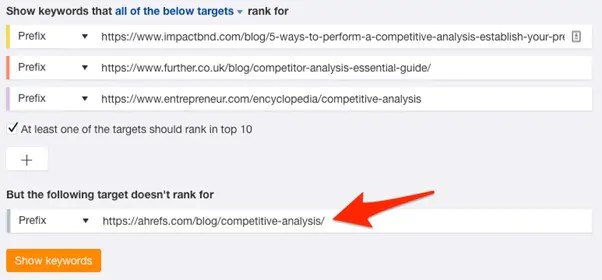
Image from www.ahrefs.com
This tool can search for keywords that other pages rank in the top 100, but your site does not.
In the following example, the option “Show keywords ranked in all targets below” has been selected. They also checked the “At least one of the targets must be ranked in the top 10” checkbox to keep the results as relevant as possible. Next, the “Show keywords” option was selected:
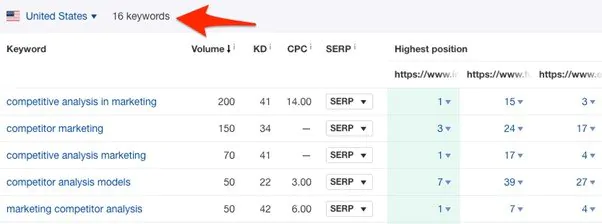
Image from www.ahrefs.com
There were a total of 16 results, many of which are subtopics that fall under the heading of competitive analysis.
The fact that the page they used to analyze didn't rank for any of these keywords shows that they probably forgot to mention these things in the content.
The solution to this problem is to make a small update to the post or page to talk about what is not being mentioned. For example, you could add a section on “competitive analysis in marketing”. Or about various “competitor analysis models”.
Not only can this help the page rank for these keywords, but it can also increase the relevance of the page's topic. In turn, this can also boost the rankings of other related keywords.
This just reminds us that Google is an algorithm. It examines the content of your page to understand what it's about. By talking about things related to your main topic, you effectively increase Google's trust in the page's subject.
6. Take advantage of competitors' dead pages
Most websites have some dead pages, including your competitors, and you can take advantage of them to build links. And if your competitors' dead pages are relevant - or at least semi-relevant - to your business and have backlinks, then there's room to earn those backlinks for you.
The first step is to find your competitors' dead pages. To do this, you can use the Site Explorer, like the example below:
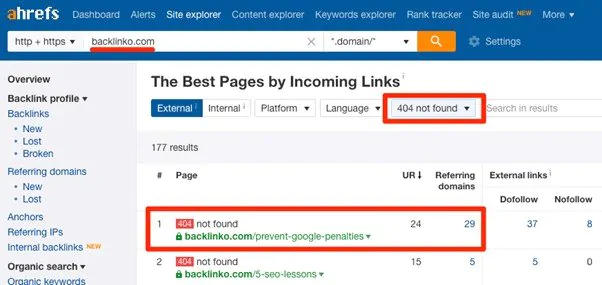
Image from www.ahrefs.com
Look at the list of URLs and see if any are relevant or semi-relevant to your business. In this case, the issue to avoid penalties is related to SEO. The result of the example above shows 29 referring domains.
By clicking on the link “View on Archive.org” you will be able to see what the content was that is now faulty:
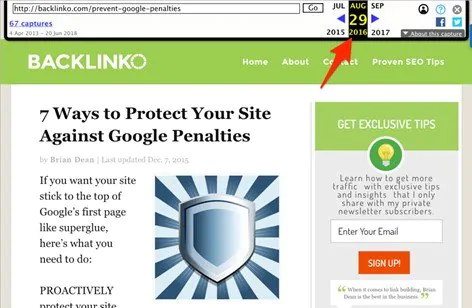
Image from www.ahrefs.com
The content was a blog post on how to avoid Google penalties. The fact is: since the page is dead, 29 people are now linking to nothing but an error page.
The next step is to see if your blog has similar content that can serve as a relevant replacement for these inactive links. Let's assume that you already have content on how to avoid a Google penalty, so you can use it. If you don't, just create something.
Now take a look at the backlinks report for the inactive page in Site Explorer:
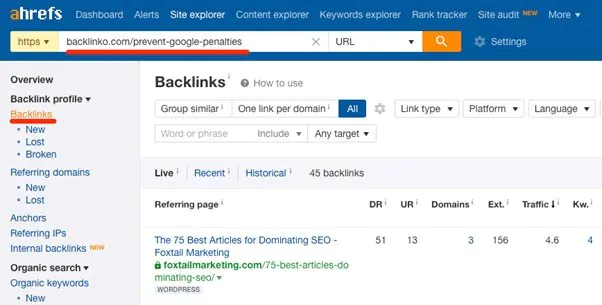
Image from www.ahrefs.com
This will give you a list of people you can contact and alert about your broken link. But you can do more than just alert them; you can also gently suggest your content as a relevant replacement.
You can reach all these people, but you should only be interested in creating high-quality links, so you can add some filters to narrow down your list of potential customers:
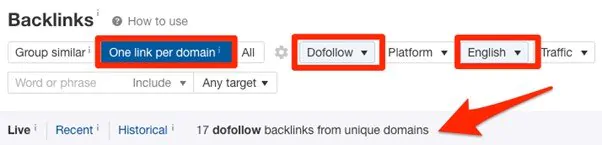
Image from www.ahrefs.com
Here's a list of 17 people from whom we can potentially gain links. Now all you have to do is find their e-mail addresses and contact them.
You can send something like
“Hi, I saw that your link to (URL) is dead.
We have something similar: (Your URL). You may want to change the link.”
Conclusion on SEO techniques
Website optimization is always being updated and there are many SEO techniques. This post lists just a few of the many tactics you can use to increase traffic for your website.
We hope you enjoyed the content and that the tips will help you apply the best SEO techniques this year!
Source: www.ahrefs.com
Looking to optimize your website? UpSites can help! Click on the button below and get professional SEO advice from us!
Get a quote
Frequently Asked Questions
Why is it important to optimize titles and descriptions?
Optimized titles and descriptions increase the click-through rate (CTR) in search results, ensuring that more people click on your site, even if it is already well positioned.
How can internal links help SEO?
Internal links help to distribute authority between the pages of your site, improving the ranking of underperforming pages and making the site more navigable for users.
Why should I update old content?
Updating old content can increase organic traffic, as Google tends to prioritize pages with recent and relevant information, as well as improving SEO performance.
How can I identify content opportunities with low competition?
Tools such as Ahrefs' Content Explorer allow you to find topics that attract organic traffic with few backlinks, identifying opportunities to create highly relevant, low-competition content.

Lucas Pelisari
Lucas Pelisari has been an SEO and content specialist at UpSites for over 6 years, working on the creation and optimization of digital strategies focused on lead generation and organic growth.With experience in website development projects, on-page SEO and link building, he works directly on structuring content and pages aimed at positioning on Google and acquiring qualified traffic.Throughout his career, he has worked on projects for companies such as Kommo, Aldanth, Physical Care, In4, Design.com, Adaptive, Clipto and YeSim, as well as several other clients served by UpSites.He works on projects in different niches, including technology, SaaS, services and local businesses, with a focus on performance, conversion and scalability.Her work is directly linked to lead growth and increased organic visibility, with projects that have seen consistent traffic gains after implementing SEO and content strategies.His content covers topics such as professional website creation, SEO, page structure, performance, user experience and digital growth strategies, always with a practical approach based on real market scenarios.Professional networks:LinkedIn: https://www.linkedin.com/in/lucas-widmar-pelisari-78920033/Instagram: https://instagram.com/lucaswidmar
See all posts
 Calculate Price Now