

Local SEO: How to Rank a Website in Regional Search in 2026?
Summary (TL;DR)
Local SEO is a website optimization strategy that focuses on improving a business's ranking in geographically targeted searches. In addition to traditional search engine optimization tools, it relies on specific factors that influence a website's positioning.
In this content, you will understand what local SEO is, how it works, and what strategies you can adopt to optimize your website for local Google searches.

Imagine this scenario: you're traveling to a new city and want to find a good place to eat pizza. Or, on the road, your car breaks down and you need a mechanic. In both cases, the first thing you do is search online for the closest place.
Google uses a specific tool to help with this: Local SEO. It allows users to easily find nearby businesses.
If you want to attract more customers organically, optimizing your website for local SEO is essential. We'll show you how and why to invest in this strategy.
What is local SEO?
Local SEO is an optimization for search engines that improves a business's visibility for searches conducted in a specific geographic area.
In general, Google understands searches that use terms like these as localized searches. “near me” or the name of a specific place (for example, “Art Therapy in Granja Viana”Thus, for regional searches, the engine immediately interprets it as a geolocated search and presents options within that region.
However, localized results can also appear according to search intent of certain keywords. Observe:
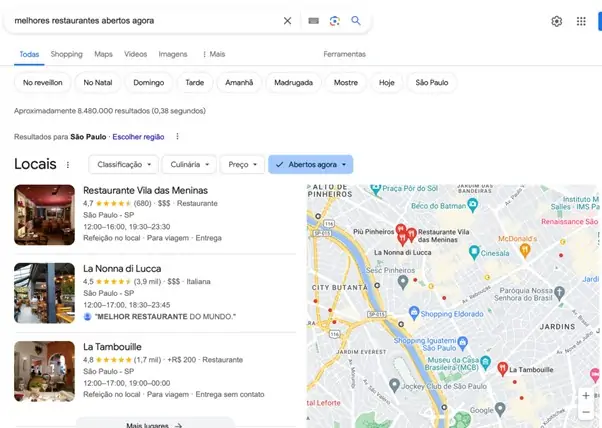
In the above research, it was not necessary to specify the region: due to the way the question was asked, the Google search engine already understands that it can present best results near me, using my real-time location. And to define what those results are, it relies on local SEO.
What is the difference between local SEO and SEO?
The main difference between website optimization (General SEO) for local SEO is in Google's use of specific tools that affect ranking.
Although, in general, the main SEO strategies are also important when we talk about localized searches, there are particularities in this second type of search. Here are some:
- The presence of a map for location, which guides the user to understand how close they are to a particular establishment;
- The use of user reviews, which help the user understand how others experienced a particular place;
- The presence of details about the establishment, as an average price, average service time, in addition to the possibility of finding images made by other people and information such as menus, available services, etc.
Why is local SEO important?
The main function of local SEO is to make your business discoverable by different people who may have never heard of it before. In this regard, it is an important tool for anyone who wants to attract new customers e stand out in the face of competition.
Although e-commerce and online sales are gaining more and more space in consumers' lives, “In-person” businesses have not lost their importance. Additionally, depending on your type of business, good local SEO optimization can be the difference between a customer choosing your business or a competitor's.
Think, for example, about a person who needs a mechanic because they are facing an unexpected problem on the road. If your website is optimized for local SEO, they can find you; if it's not, they will definitely find someone else.
Do you need to improve your website's SEO and receive more qualified traffic?
Click the button below and get a fast quote for our SEO consulting.
How does local SEO work?
Beyond the website optimization strategies Traditional SEO has three main factors that aid in its ranking. They are:
- A Relevance of your business to that search, meaning how relevant your business is to what the user is searching for. If you have a restaurant website Italian, for example, is more likely to appear for someone searching for “pizza” or “pasta” than for someone searching for “sushi.”.
- A distance from your business to the user. In general, closer businesses tend to rank better, as they require less effort from the user.
- O highlight what your business receives, meaning how much it differentiates itself from its competitors, whether through a good number of positive reviews or because its digital presence is consolidated.
This means that for those who want to rank using local SEO, extra care must be taken when optimizing the site.
How do I optimize my website for local SEO?
Express Website: optimize a website for local SEO, it's not enough to follow the “traditional” search engine optimization rules. Below, you'll find the main precautions you should take to ensure a better ranking for your site. Check it out!
1. Find the right keywords
When we talk about keywords for local SEO, we're talking about those that have greater relevance for your type of business and one good search volume. This means that the user uses those terms to find what they're looking for — and, if it's well-used on your site, that means finding you.
But remember to also focus on related and secondary, long-tail keywords.
2. Have a contact page
So that Google (and the user, of course) understands where you are and who you are, it is essential to have a clear and well-built contact page. On it, you should include the your store's address e all relevant information to be “found”.
If you have more than one store, it's worth thinking about strategies like “find the nearest [store] to you!” pages.
Optimize your website for mobile devices
It's no surprise: mobile devices represent the most searches Not Google. That's exactly why your website needs to be optimized for them — which, within SEO, is usually known as “mobile first”This is an important ranking tool even outside of local SEO, but especially for it.
4. Use structured location data
The use of structured location data (SCHEMA) is indispensable for anyone who wants to rank in local SEO. After all, through them, Google can have more information about your business and make it available to future clients.
5. Have an optimized Google Business Profile
O Optimized Google Business Profile it is also important for those who want to rank well. Through it, Google has all the information you need to present your website in a local search. But be careful: ensure all data is filled in correctly!
6. Focus on reviews
Reviews are also a tool that makes all the difference in ranking when we talk about local SEO. After all, It is through customer reviews that your business becomes more or less known.. Therefore, focus on getting as many reviews as possible—and the more detailed (and positive!) they are, the better.
7. Produce relevant content
Finally, for those who really want to rank with local SEO, it's worth building a digital presence of greater authority. To do this, investing in the production of relevant content is fundamental. Therefore, consider having a blog about your business's relevant topics that ranks organically for other keywords associated with your service or product.
Do you need to improve your website's SEO and receive more qualified traffic?
Click the button below and get a fast quote for our SEO consulting.
Advanced Local SEO Strategies
Express Website: Improve your website's optimization And to stand out even more in local search results, it is essential to implement advanced local SEO strategies.
Here are some best practices, examples, and tips based on effective techniques:
Google Map Pack:
- How it worksThe Map Pack displays the top three local results along with a Google Maps view. To appear in the Map Pack, you need to optimize your profile on Google My Business.
- Rank Tracking: Utilize tools such as Local Falcon to track your rankings in the Map Pack in different areas of the city. This helps you understand where you are strongest and where you need to improve.
Consistent NAP Citations:
- What isNAP (Name, Address, and Phone) should be consistent across all online locations, including your website, Google My Business and local directories. Tools like Whitespark help audit and correct inconsistencies.
- ImportanceNAP citations help Google confirm the authenticity and location of your business, improving rankings.
Online Reviews:
- Review CollectionEncourage your customers to leave positive reviews on Google and other relevant sites. Respond to all reviews, whether positive or negative, showing that you value their feedback.
- ImpactReviews are one of the most important factors for local SEO, influencing consumer trust and your business's visibility.
Local Backlinks:
- Local PartnershipsBuild relationships with other local businesses for relevant website links. This includes distributors, suppliers, and business partners.
- ExamplesParticipating in local events and obtaining website links from sponsors or local chambers of commerce can be highly beneficial.
Regional Content:
- Location PagesCreate specific pages for each location where your company operates, using local keywords and relevant information.
- ExampleA service company can have pages for “plumber in [city]” and “electrician in [city]”, each with exclusive content.
Schema Markup:
- Schema ImplementationUse structured data to mark up your address, phone number, and other important details on your website. Although Google already uses this information from your Google Business Profile, schema markup can provide additional data that aids in optimization.
- BenefitsRich snippets with star ratings or operating hours can increase the click-through rate in search results.
Competitor Analysis:
- ToolsUtilize tools like Semrush's Backlink Gap to identify where your competitors are getting citations and backlinks. This can reveal new opportunities to strengthen your local presence.
Local SEO Actions and Examples
A local restaurant can benefit greatly from these strategies. Here's an example of implementation:
- Google Business Profile OptimizationEnsure all information is up-to-date and accurate, including operating hours and attractive photos.
- Collect and Respond to Reviews: Incentivize detailed reviews and respond to all of them, showing customer attention.
- Create Localized ContentHave pages on the site for different locations, such as “best pizza in [neighborhood]” and “Italian restaurant in [city]”.
- Use schema markup.Implement structured data to highlight reviews and contact information in search results.
Conclusion
Local SEO is a powerful tool for businesses that want to increase their visibility and attract more customers in the region where they operate. With consumers increasingly relying on online searches to find local services and products, optimizing your website for local SEO is essential to stand out from the competition and capture more customers.
Implementing advanced strategies like optimizing your Google Business Profile, collecting positive reviews, consistent use of NAP citations, and creating localized content can make a significant difference in your business's search result performance. Additionally, tools like Local Falcon and competitor analysis techniques can offer valuable insights to refine your approach and ensure your business is well-positioned in all areas of the city.
The integration of these practices not only improves your business's visibility but also builds a solid and trustworthy reputation within the local community. Therefore, investing in local SEO is not just an option, but a necessity for any business looking to thrive in today's competitive digital environment.
Apply these strategies and see how your business can become a benchmark in the region, attracting more clients and increasing your chances of success.
By following these advanced strategies, you can significantly improve your local search visibility, attracting more customers and standing out from the competition.
Now that you are familiar with local SEO strategy, take the opportunity to dive even deeper into the world of SEO and check out our Guide to Creating Digital Content.
Do you need to improve your website's SEO and receive more qualified traffic?
Click the button below and get a fast quote for our SEO consulting.
Frequently Asked Questions
What is local SEO?
Local SEO refers to a form of search engine optimization that focuses on increasing a business's visibility in searches made with a specific location. It uses location-related keywords, such as “near me” or a specific place name, to show results that are physically close to the user, based on their actual or estimated location.
What is the difference between local SEO and general SEO?
While general SEO focuses on optimizing a website's visibility in broad searches, local SEO is specifically designed to improve rankings in searches related to a particular location. This includes the use of maps, user reviews, and specific establishment details like prices and menus, to help guide the user's decision more effectively than general SEO.
Why is it important to optimize a business for local SEO?
Local SEO is crucial for physical businesses that want to attract new customers in their geographic proximity. It is a valuable strategy, especially for companies that rely on local traffic, as it helps to highlight the business in front of competitors, potentially influencing customer decisions at critical moments, such as when looking for an urgent service near them.
How can I optimize my website for local SEO?
To optimize a website for local SEO, it's important to focus on several aspects: finding relevant keywords for the locality, having a clear contact page, optimizing the site for mobile devices, using location-based structured data, maintaining an optimized Google Business Profile, focusing on receiving positive and detailed reviews, and producing relevant content that establishes digital authority and improves organic ranking.

Caio Nogueira
Caio Nogueira is co-founder of UpSites and a reference in website development and SEO consultancy. With over 10 years' experience and more than 900 projects completed for brands such as KaBuM, UNIMED, USP and Nestlé, Caio stands out for his competence in digital project management.Caio has also been a guest author on influential digital marketing websites such as Neil Patel, Rock Content, Hostinger, Duda, Hostgator and Locaweb, where he has shared his expertise in SEO and content marketing.
See all posts



 Calculate Price Now