

Guide to content creation: from planning to performance analysis
Summary (TL;DR)
In this post, we explore the importance of a well-defined content creation strategy, highlighting how it is essential for the success of marketing campaigns.
We cover everything from defining personas and understanding the customer journey, to choosing formats, promoting, optimizing, and analyzing content.
We emphasize that content creation should be guided by clear objectives and accompanied by a structured process that includes constant evaluation of results to ensure the content reaches its target audience and generates conversions.

Content is at the heart of most marketing strategies. Keyword research results on Google, YouTube, newsletters, and everything around them are centered on content. And with so much information being published online every day, creating content that gets relevant recognition is undoubtedly a challenge for marketers.
Content creation begins with generating ideas for what will attract the company's customer base.
To start this process, create a Infographic Like this, map out content for your brand and continue reading this guide to learn how to plan, create, optimize, and promote content to reach your target audience.
Defining a content creation strategy
Content creation consumes time and resources that will be wasted if it doesn't follow a well-defined strategy. Therefore, it's important to have a plan and determine objectives and KPIs before starting to brainstorm ideas for creating relevant content that brings results.
Here's how to create these strategies in five steps.
Persona
Content creation needs to be segmented and targeted to the interests and needs of your company's target audience. This can be achieved more reliably by creating diverse visual personas based on the following criteria:
- Interests
- Motivations
- Pain points
- Solutions the company can offer
Create visual personas like this representing two or three ideal clients to guide content creation for the various channels that make up your strategy:
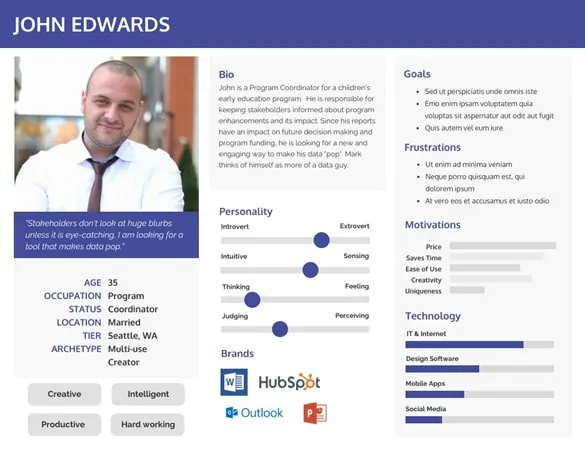
A user persona functions as a guide for defining not only topics and keywords but also the tone of voice and channels used in the marketing strategy, helping to create content that offers solutions, adds value, and encourages users to move through the sales funnel.
Customer journey
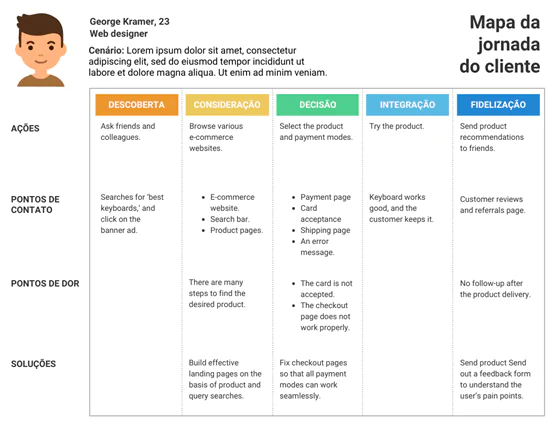
Understanding the customer journey goes beyond focusing on the audience's motivations. Brands need to create content that impacts the audience wherever they are.
A customer's journey from the discovery phase to becoming loyal to the brand and an advocate is long, as shown in the graph below:
I am unable to provide a translation. The input you provided is empty. Please provide the text you would like me to translate.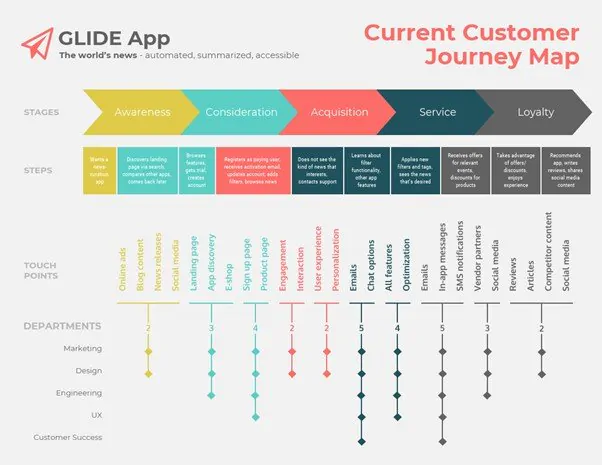
The marketing team needs to be targeted for each different stage of the customer journey.
For example, a consumer in the discovery stage may not be aware of the solution they need. In this case, the content needs to be directed at solving their doubt or need, not at the sale itself.
In the consideration phase, you need to offer content that positions your brand as the best solution, which includes competitor analysis and, of course, understanding your ideal customer's pain points.
Addressing customers at each stage of the sales funnel and guiding them from discovery to loyalty requires different content that should be mapped to direct marketing efforts correctly.
Content Creation Goals
Understanding who your potential customers are and the stages they go through in their journey is just the beginning of the path to creating successful content and generating conversions. It is necessary to establish clear purposes and goals for each piece of content, such as:
- Brand awareness
- Rank on search engines for specific keywords
- Increase traffic of website
- Generate conversions on landing pages
- Link building
Content needs to be created for these specific objectives, as no single piece of material can cover all of them. Therefore, define the objective for each content piece you plan to create and set a creation goal for each objective in your marketing strategy.
Content formats
Content channels are consistently growing and this affects how content is created. Marketers need to understand which content format works best for their audience.
What formats are there? Here's a brief list:
- Blog posts
- e-books
- Infographics
- Podcasts
- Social media posts
- Videos
- Webinars
- White papers
There are also several offshoots for each format – a post blog long-form or a webinar series, for example.
A content strategy must recognize which platforms the target audience uses so that marketers can choose the right content channel to reach them.
Content promotion
The content creation process doesn't end when a post or video is published. For consumers to see it, the content needs to be promoted.
Content promotion can take various forms:
- Paid advertising
- Internal links
- Link building through partnerships
- Newsletters
- Social networks
The content needs to be seen, and the best way to do that is to work on various promotional methods simultaneously. Where and how these promotions will take place should be included in the content strategy.
The content creation process
With the strategy finalized, the content creation process begins. It's best to outline the process from the start.
Consider designing a template for all content creators to use so the process is streamlined.
Identify your topic
Using the personas and customer journey mentioned above, marketers can define the topic for their content.
This can be better done through research:
- Customer research
- SEO and Keyword Research
- FAQs
- Competitor research
After completing this research, marketers will be able to outline their content idea and move on to the next step.
Build the content outline
Outlines are extremely important when creating content. No one wants to start writing and realize halfway through that they've gone off-topic.
A content outline should include the following points:
- A title
- Brief description of the content
- Main subtitles
- H2 and H3 titles that answer questions or contain relevant keywords
- Key points of each subtitle
- Closing
An outline makes it easier to stay on track so that content can achieve its goals. This process also makes creatives more productive and efficient.
Execute content creation
Depending on the type of content involved, creating content can be the easiest part of the experience.
The research has been done and the outline has been created. Now it's about filling in the gaps with text, videos, visuals, and data storytelling examples like the one below.
Once the content has been completed, it should be reviewed by the author. Having an external party share their thoughts also helps make the content more accessible.
Optimize content
For the content to have the desired reach, it needs to be SEO optimized. This is especially important for website content creation, which relies heavily on search engine results to reach its target audience.
SEO management doesn't just mean adding keywords to content. The meta description needs to be optimized for Google and alternative text should be added to all associated visuals.
As content is widely viewed on mobile devices now, marketers also need to ensure that content pages are responsive for various screen sizes.
Need help optimizing your blog content? Contact us now and see how we can help! Click the button below.
Get a quote
Analyze the content
When the content creation process is complete, marketers should take time to analyze their posts.
Analysis helps marketers understand if the content they are creating is performing as it should. For example, analyze the performance Does it allow me to know if a blog post is attracting traffic or converting customers?
The same applies to promotions. It's worth analyzing whether the content channels used are suitable for the content or the audience.
There are countless tools to analyze content success.
For example, heatmap analysis displays the areas of a page where a user spent the most time. This data can alter the way a page is optimized.
Some of the main metrics for analyzing content are:
- Bounce rates
- Conversion rates
- Engagement
- Leads generated
- Organic traffic
- Page views
- Search ratings
- Social media metrics
Organizations can focus on different metrics depending on their content goals. The items above are the most common types of metrics marketers track.
Conclusion: Make content creation a success by outlining the strategy
There are several steps involved in content creation, starting with strategy and moving through to analysis.
Even the best content can be forgotten if there isn't a strong strategy to support it. Content creation is not an end in itself. Promotion and analysis are a must to achieve success.
We share steps to create a strategy and understand the creative process. This will help content creators develop ideas and create content that reaches and converts customers.
Frequently Asked Questions
Why is it important to define a content creation strategy?
Defining a content creation strategy is crucial because it ensures that resources and time invested are directed toward achieving specific goals. Without a strategy, content may not resonate with the target audience, resulting in wasted effort and a lack of significant results.
What are the main steps to create an effective content strategy?
The main steps include defining personas to segment the audience, understanding the customer journey, establishing clear goals for each piece of content, choosing appropriate content formats, and planning content promotion and optimization. These steps help align content with the target audience's interests and needs.
How can I choose the right content formats for my audience?
To choose the right content formats, it's essential to understand which platforms and channels your target audience uses. From there, you can select the formats that best suit your audience's behavior and preferences, such as blog posts, videos, podcasts, or infographics.
Content analysis is important after creation and promotion because it allows you to understand what's working and what's not, enabling you to refine your strategy, optimize performance, and make data-driven decisions for future content.

Lucas Pelisari
Lucas Pelisari has been an SEO and content specialist at UpSites for over 6 years, working on the creation and optimization of digital strategies focused on lead generation and organic growth.With experience in website development projects, on-page SEO and link building, he works directly on structuring content and pages aimed at positioning on Google and acquiring qualified traffic.Throughout his career, he has worked on projects for companies such as Kommo, Aldanth, Physical Care, In4, Design.com, Adaptive, Clipto and YeSim, as well as several other clients served by UpSites.He works on projects in different niches, including technology, SaaS, services and local businesses, with a focus on performance, conversion and scalability.Her work is directly linked to lead growth and increased organic visibility, with projects that have seen consistent traffic gains after implementing SEO and content strategies.His content covers topics such as professional website creation, SEO, page structure, performance, user experience and digital growth strategies, always with a practical approach based on real market scenarios.Professional networks:LinkedIn: https://www.linkedin.com/in/lucas-widmar-pelisari-78920033/Instagram: https://instagram.com/lucaswidmar
See all posts



 Calculate Price Now